

On this page — view sections
Mumbai to Lucknow Shifting Charges: Planning Budgets
Treat the figures below as planning budgets, not a fixed tariff. They help you decide between options before you share an inventory. The written quote, prepared after we review your inventory and access details, is the figure that applies.
| Move | Planning budget | What the range is meant to describe |
|---|---|---|
| Few items (part load) | ₹9,500–₹17,500 | A short named list, for example a few cartons, a mattress and one or two small pieces, not a full room set |
| 1 BHK | ₹18,500–₹32,500 | One bedroom, a living area and kitchen basics, with a bed, a wardrobe and common appliances |
| 2 BHK | ₹27,500–₹45,500 | Two bedrooms with the furniture and appliances of a typical family flat |
| 3 BHK | ₹38,500–₹60,500 | Three bedrooms with larger furniture sets, more appliances and a fuller kitchen |
| 4 BHK | ₹50,500–₹78,500 | Four bedrooms with a substantial inventory |
| Larger homes and villas | Scoped individually | Priced from a detailed inventory and a site review, not from a range |
These ranges are a general household guide. The transport mode (shared or dedicated) is named in your actual quote. A dedicated vehicle is priced separately on the same inventory, so ask for that figure if you want to compare modes.
| Item | Planning budget | Assumption behind the range |
|---|---|---|
| Small office | ₹30,500–₹50,500 | About 6 to 8 workstations with chairs and computers, plus a few cabinets or files. IT setup and data backup are not included. Retail stock and machinery are quoted separately. |
| Hatchback car | ₹12,500–₹17,500 | Standard hatchback, vehicle only |
| Sedan | ₹15,500–₹22,500 | Standard sedan, vehicle only |
| SUV | ₹19,500–₹28,500 | Standard SUV, vehicle only |
| Bike or scooter | ₹6,000–₹8,500 | Standard motorcycle or scooter |
| Heavy bike | ₹8,500–₹11,500 | Larger or heavier motorcycle |
Whether GST sits inside or on top of any figure is shown line by line in the quote. If you want a car or bike to travel with household goods, share both inventories so the plan and the quote cover them together.
What Changes a Mumbai to Lucknow Moving Quote
Two households with the same BHK size can receive different quotes. These are the factors that usually explain the gap.
- Volume and weight: the number of cartons, the size of the furniture and the density of the load decide how much vehicle space you need.
- Item types: a refrigerator, washing machine, glass-top table or large wardrobe needs more packing and handling time than the same space filled with cartons.
- Transport mode: a dedicated vehicle and a shared part load are priced on different logic, and the transit window differs.
- Packing depth: full packing of every room costs more than packing only fragile and loose items.
- Access at both ends: floor, lift availability, the walk from vehicle to door, and whether the vehicle can stop near the entrance.
- Pickup date: a fixed date on a busy day gives us less room to consolidate than a flexible one.
- Extras: crates, furniture dismantling and reassembly, technician work, stair or long carry, waiting time, storage and a second delivery point.
Ways to keep the budget down
- Remove items you will not use in Lucknow before sharing the inventory. Reducing the load can change the assessed space, although minimum charges may still apply.
- Ask for the shared part-load figure alongside the dedicated one if your goods are modest and your date is flexible.
- Tell us about stairs, narrow entrances and parking early, so the quote includes them instead of adding them later.
- Pack and label items such as books and clothes yourself only if the quote states that arrangement.
What a Written Quote Should Say Is Included or Extra
Basic packing, loading, transit and unloading are included as scoped in the quote. The items below are where final invoices most often differ from expectations, so each should appear in the quote as either included or extra.
| Item | Why it matters |
|---|---|
| Packing materials for the listed items | Confirms which rooms and items are covered by the figure |
| Furniture dismantling and reassembly | Beds, wardrobes and modular units can take real time at both ends |
| Wooden crates for fragile or valuable pieces | Crating is a separate scope from standard wrapping |
| Technician work for AC, geyser, TV wall mount or similar | Uninstalling and installing is usually a separate skill from packing |
| Tolls and parking | Shows whether they are inside the figure or charged as incurred |
| Stair carry or long carry | Priced by floor and distance when there is no lift or no vehicle access |
| Waiting time | Covers delays caused by lift, society or access timing |
| Storage | Needs a start date, a period and a rate if delivery is delayed |
| Redelivery | Applies if a delivery attempt cannot be completed at the address |
| GST | Shows whether figures are inclusive or exclusive |
| Optional transit cover | If chosen, the declared value and premium should be shown separately |
Mumbai Lucknow Distance and Delivery Time
The road distance from Mumbai to Lucknow is about 1,500–1,700 km, depending on the road alignment used and on the exact pickup and delivery addresses. A mapping service currently shows about 1,631 km and roughly 26 hours of driving for a passenger car using NE4. That is a passenger-car estimate, not a moving-vehicle time, because a loaded vehicle also deals with loading, consolidation, rest and access at the destination.
| Mode | Where the clock starts | Planning window |
|---|---|---|
| Dedicated vehicle | After dispatch from the Mumbai region | About 3–5 days |
| Shared part load | From pickup, including consolidation | About 5–8 days |
| Car and bike | After pickup (preliminary) | About 3–6 days |
For a dedicated move, packing and loading happen before the clock starts, so a large home can add a day or more before dispatch. For a shared move, consolidation is already inside the window. These are planning windows, and the quote should state the pickup date and the transport window for your booking.
What can stretch the window
- Waiting for a shared vehicle to fill before it leaves.
- Road works, closures or weather along the way.
- A late or unavailable lift or society entry at the Lucknow end.
- An incomplete delivery address or no receiver at the door.
Agree the receiving appointment
Keep the Lucknow receiver reachable during the expected arrival window and confirm the keys, entry arrangement and unloading point before dispatch. The carrier selects a suitable commercial route; a passenger map’s road list does not fix the truck itinerary. If possession is uncertain, discuss holding or storage before the load leaves Mumbai.
Plan both Lucknow delivery appointments before pickup
A two-address delivery needs two ready properties and two reachable receivers. Tell the booking team the available hours, keys and any goods-lift slot at each destination before the loading plan is final. The order on the allocation sheet must match the order the carrier agrees to undertake.
| Stage | Question to settle | What to record |
|---|---|---|
| First stop A | When can this property receive, and which A-series goods can be unloaded there? | Receiver, access, own package list, agreed scope and appointment |
| Second stop B | How much time does the first stop and the journey between properties add? | Separate receiving slot, B-series list, receiver and any waiting or extra-stop amount |
| Either property not ready | Can the schedule change, or is a separately agreed holding or storage arrangement needed? | Approved revised destination/date, intake count if stored and later-delivery price |
Use the full indicative window for the mode: 3–5 days after dispatch for a dedicated vehicle or 5–8 days from pickup for a shared part load. Packing precedes dedicated dispatch. Ask which receiving appointment the quoted window covers and how a second drop changes it; the road estimate alone does not book two building slots.
Check current conditions near the moving date and ask the booking contact to update both receivers if the expected arrival changes. Arrange your own travel and any technician visits against the confirmed plan.
Planning the Mumbai-Side Pickup
Pickups in the Mumbai region, from suburbs to Thane and Navi Mumbai, are confirmed by address. Many apartment societies have rules for goods movement, so it helps to check these before you fix a date.
- Ask your society about permitted move-out hours and whether a lift can be reserved for the loading.
- Tell us the floor, the lift size and where a vehicle can stop. A longer carry from the vehicle to the door is a scoping detail, not a surprise.
- Share the exact pickup address and a landmark, since the same locality name can cover very different access conditions.
- Keep the entrance, passage and parking space clear on the day.
- Have the person handing over the goods present to sign the loading count against the inventory.
Lucknow Delivery: Address Details That Decide Access
A locality name does not tell us how a vehicle will reach your door. Two addresses in the same locality can differ completely, one on a wide road with a gate and another inside a narrow lane. We therefore plan from your actual delivery address and make no assumption about a whole locality.
| Locality | Postcode in that list |
|---|---|
| Hazratganj | 226001 |
| Aminabad | 226018 |
| Rajajipuram | 226017 |
| Sadatganj | 226003 |
| Indira Nagar | 226016 |
| Gomti Nagar | 226010 |
This table is only a set of examples. It shows that Lucknow does not run on one postcode and that different localities carry different codes. It comes from a broad locality directory, not a flat-level lookup, so always use the PIN printed in your property's postal address.
What we ask for in your delivery address
- Locality and a nearby landmark.
- Khand or sector, where your area uses that structure.
- House number, building or tower, and floor.
- The road-facing entrance, and whether a vehicle can stop at or near the gate.
- Lift availability and any move-in timing rule set by the society or building.
- Name and phone number of the person receiving the goods.
- The property PIN as shown in its postal address.
If the road in front cannot take the vehicle, tell us in advance. The quote can then state how the goods will be carried from the nearest practical point, or whether a smaller vehicle transfer is needed, and what that adds.
A project name or brochure location is not a full postal address
For a home described as near Shaheed Path, Sultanpur Road or Gomti Nagar Extension, give the property postal address and PIN, project, tower or house number and road-facing entrance. Use your own allotment or tenancy papers rather than replacing the address with a broad marketing description. Confirm any discrepancy with the property contact before it goes on the quote.
For a township, official colony or other controlled-entry property, ask the authorised office about the actual move-in approval, crew or vehicle information and unloading slot it requires. Tell the booking team who is arranging it. For any house in an inner lane, show photographs and the actual carrying route instead of assuming access from a locality label.
Delivering to Two Lucknow Addresses: Allocation Sheet
List the bicycle and its loose accessories separately
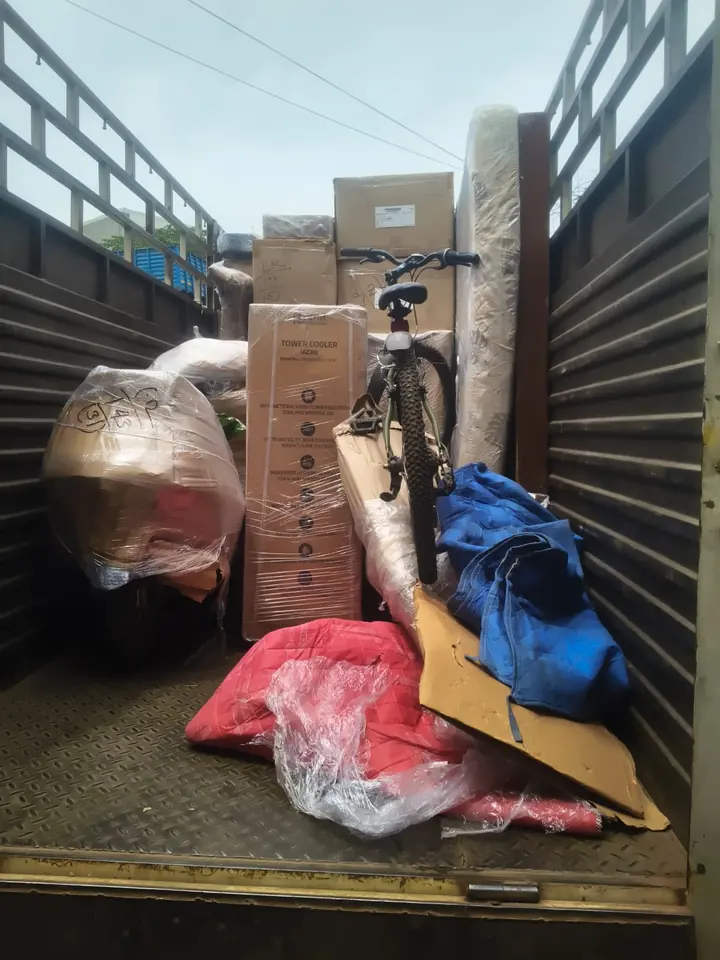
A bicycle can sit beside the household load while its small accessories are packed elsewhere. The bicycle and mixed packages in this photograph make that easy-to-miss split worth checking.
For a Mumbai to Lucknow move, photograph the cycle and list detachable accessories such as lights, baskets or a pump. Agree whether anything will be removed for packing and how those parts will be labelled. Tell the team about existing scratches or loose fittings before protection is applied.
If delivery is split between two addresses, give the cycle and its accessory package the same destination code. Count both at the correct stop before closing that part of the handover.
Some customers need part of the goods at a temporary Lucknow address and the rest at a final home, or some at a home and some at an office. Two delivery points are not automatic. Availability is confirmed before booking, and the second stop is agreed in writing, with its own handling and cost.
The sheet below is an example of how we would record such a split. It is an illustration, not an actual job.
| Destination | Exact address and PIN | Item IDs and count | Receiver | Unloading scope and sequence | Extra-stop approval |
|---|---|---|---|---|---|
| A: temporary home | Full address and property postal PIN written on the sheet | A01 to A06, 6 cartons | Named person at A, with phone | Unloaded first, cartons placed in listed rooms | Agreed in writing before booking |
| B: final home | Full address and property postal PIN written on the sheet | B01 to B09, 9 cartons | Named person at B, with phone | Unloaded second, cartons placed in listed rooms | Covered by the same written agreement |
In this example, 6 cartons at A plus 9 cartons at B make 15 cartons in total. Furniture is named item by item on its own lines and is not counted inside those 15 cartons.
How it works if you need it
- Each carton or item is labelled at packing with an ID that matches the sheet.
- Counts are checked and signed at each stop by that stop's receiver.
- If an address changes after loading, tell us. The change is quoted and agreed, not assumed.
- A second stop can add time, cost and a longer window. The quote should say by how much.
Make the first drop accessible without losing a safe load plan
Tell the loading team the agreed stop order before packing finishes. Ask it to plan access to the A-series packages without unnecessary handling of the B-series goods, while keeping heavy pieces secure and protecting fragile items. Do not treat a simple first-in/last-out rule as a substitute for the actual loading assessment.
Give each receiver the full allocation sheet plus their own stop list. The receiver at A should acknowledge the A packages actually received and record any exception, rather than signing for all 15 example cartons. Keep the B-series count open for its own handover. A cycle and its accessory package should carry the same destination code.
Limit what you send to a temporary address
If stop A is a short stay, choose what you will really use there and confirm that the property has space for it. Any later move from A to the final home is another job to assess and price. Keep the list small where practical, but do not remove an item from the agreed inventory without confirming the change.
If the final home at B is not ready, tell the booking team before dispatch. Agree where those goods can wait, the handling and count at intake, who may release them and the later-delivery cost. Holding the B set or changing the drop order should be a confirmed arrangement, not an assumption made at stop A.
Household, Few-Item, Office, Car and Bike Services
Household shifting
Packing, loading, transit and unloading for 1 BHK to 4 BHK homes, with larger homes scoped individually. Furniture dismantling, crating and technician work are stated as included or extra item by item in the quote.
Few-item and student part load
For cartons, a mattress, a cycle or a small appliance, a shared part load usually makes more sense than a whole vehicle. Send a list with counts and approximate sizes. The more specific the list, the closer the quote will be to the planning budget. Items that are awkward, very heavy or very fragile should be named so they are scoped, not discovered at pickup.
Office relocation
Our small-office planning budget assumes about 6 to 8 workstations with chairs and computers, plus a few cabinets or files. IT setup, data backup, retail stock and machinery are outside it. For an office move, label workstations and cabinets by destination, back up data yourself before pickup, and confirm lift booking and entry rules at both buildings.
Car transport
Share the make, model and operating condition, and tell us about any existing damage. Remove personal belongings from the car. The quote should state how the vehicle is carried, the inspection note at pickup and the preliminary 3–6 day window after pickup.
Bike transport
Share the model and condition. Note accessories, and obtain the assigned transporter’s preparation guidance before pickup. Heavier motorcycles are priced in a higher band. The quote should state how the bike is carried and the preliminary 3–6 day window after pickup.
Packing, Dismantling and Reassembly
Packing for a long-distance move has to cope with a multi-day journey, so the scope matters more than the slogan. The quote should say which rooms and items are packed, which materials are used, and who is responsible for each step.
- Fragile items such as glass, mirrors and crockery need separate wrapping and careful positioning in the vehicle.
- Prepare appliances according to their manufacturers’ instructions, including draining water or fitting model-specific transit bolts where required. Arrange technician work separately.
- Cartons should be labelled by room and, if you use the allocation sheet, by item ID.
- Furniture dismantling and reassembly are stated per item. Beds, wardrobes and modular units are the usual candidates.
- Technician work such as AC removal and installation, geyser fitting or wall-mounted TV setup is stated separately.
At delivery, goods are unloaded, counted against the inventory and placed as agreed. Anything not in the written scope is confirmed on the spot, not assumed.
How a Mumbai to Lucknow Move Runs
- You share an inventory: a room-by-room list for a household, a named list for a part load, or a workstation count for an office. For vehicles, share make, model and condition.
- You tell us the floor, lift, entrance and parking at both addresses, and who will receive the goods in Lucknow.
- We prepare a written quote naming the scope, the mode, the extras and the transport window.
- You review the quote, ask questions on anything marked extra, and confirm the booking terms.
- On pickup day, the goods are packed and loaded, and the loading count is checked against the inventory.
- The carrier dispatches toward Lucknow with an expected arrival window; use the agreed contact to confirm dispatch, progress and any change to the delivery plan.
- At Lucknow, goods are unloaded, counted against the inventory and placed as agreed. Assembly and other extras proceed as quoted.
- You sign the handover count and note any concern on the spot.
Why ALPM and How to Choose Any Mover
We run this route on direct contact, itemised scope and a handover count. That means you speak with the business that quotes the move, the quote lists inventory and access items, the transport window is agreed, and the handover is checked against your inventory.
Business details
Agarwal Logistics Packers and Movers, also written Agarwal (ALPM) Packers and Movers. Mumbai-region contact: Shop 10, Omkareshwar Apartment, Rewale Talavo, Thane 400607. Phone +91 94671 86002. Email info@agarwalpackermoverindia.com. GST 36FDRPM0957B1ZC, trademark TM 7901417, Udyam UDYAM-TS-02-0069425. We are independent of similarly named companies, so check the name and GSTIN on any quote or invoice you receive.
Questions worth asking any mover
- Is the quote built on my written inventory, and does it list what is extra?
- Which mode is quoted, and where does the transport window start?
- Who is on site at pickup and at delivery, and who signs the count?
- What happens if the access plan at either end does not work?
- How are changes to the inventory or to an address handled and priced?
Storage and Transit Cover as Options
Storage
If your Lucknow property is not ready on the delivery date, storage may be arranged as an option. Availability, location, start date, period and rate are confirmed in writing before booking, and any storage and redelivery charges are stated separately. Tell us early, because it changes the delivery plan.
Transit cover
Transit cover is an optional extra, and we can help you arrange it as scoped. If you choose it, the declared value and the premium should appear separately in the quote, and you should read the policy terms and exclusions before booking. Check the insured risks, valuation and claims requirements; retain the inventory and condition records.
Booking Terms to Settle Before You Confirm
Before you confirm, make sure the quote or booking note fixes the following points.
- The mode, the pickup date and the transport window.
- The inventory, the counts and the packing scope.
- The pickup address and the Lucknow delivery address, with PIN and receiver.
- What is included and what is extra, using the table earlier on this page.
- The payment schedule, including any advance.
- Rescheduling and cancellation terms.
- Your choice on storage and transit cover, if any.
What not to put in the goods vehicle
Carry cash, jewellery, important documents and daily-use items with you. Perishable food, flammable or hazardous items, pets and live plants are not suited to a multi-day goods journey. Check the quote for any further excluded items.
One record set for both delivery points
Keep the quotation, final inventory, allocation sheet, consignment reference and payment receipts together. Send each receiver the current version and keep the signed acknowledgement from each stop. If an address, count or sequence changes, obtain the revised scope before work and make sure both receivers receive it.
For business-owned equipment or stock, ask the goods owner or accounts team which movement documents apply to the actual shipment, ownership and values before dispatch. An employee reimbursement may also require an approved quotation and particular invoice details; confirm that format separately from the physical delivery count.
Checklist: Before Pickup, at Delivery and Common Mistakes
Before pickup
- Declutter and finalise the inventory.
- Confirm society permission, lift booking and parking at the Mumbai address.
- Back up office or personal data, and empty appliances as advised.
- Photograph valuable or fragile items and any vehicle for condition records.
- Keep valuables, documents and essentials with you.
At delivery in Lucknow
- Be present or name a receiver who can sign.
- Confirm lift and entry arrangements with the building before the vehicle arrives.
- Check the count against the inventory before signing.
- Note any damage or missing item on the handover record at that moment.
Common mistakes
- Booking from a headline figure without checking what is included.
- Sharing a locality name instead of an exact address.
- Treating a passenger-car travel time as a moving-vehicle time.
- Leaving stairs, lifts or narrow access out of the brief.
- Changing the inventory or address after loading without agreeing the effect on the quote.