
Residential
Apartments, independent houses and high-rise buildings, using the lift or stairs. Tell us the floor, lift size and the largest item.

Labour to load your own truck, unload at your new home, or handle both ends of a move. Tell us what is being moved, how many floors and how far the truck can park, and you get a written quote for the actual job.
Loading is carrying goods from your home or office to the vehicle and placing them so they don't shift on the road. Unloading is the reverse: taking them off the vehicle and carrying them to the rooms you choose. Both look simple, but they involve the heaviest lifting of a move, often on stairs, in narrow corridors and within building time slots, so the access and crew need planning.
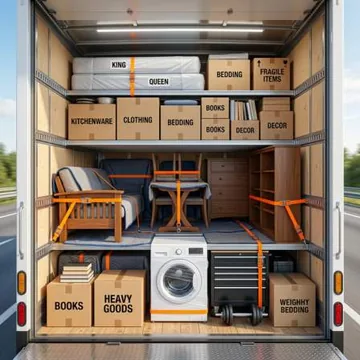
Good loading puts heavy, stable items low and fragile cartons where nothing heavy rests on them. Good unloading checks that everything has arrived, then places each item where it belongs instead of leaving it in a heap at the door.
Pick the scope that matches what you have already arranged. Labour-only work does not include the vehicle, transport or packing unless you add them.
| Scope | What the crew does | What you arrange |
|---|---|---|
| Loading only | Carries your packed goods to the vehicle and loads them | The vehicle and driver, packing (unless added), and unloading at the other end |
| Unloading only | Unloads at your new address and carries goods to the agreed rooms | Packing, loading and transport, plus the vehicle's arrival time |
| Both ends | Loading at the first address and unloading at the second | The vehicle and transport. The crew at each end may differ. |
| Full move | Packing, loading, transport, unloading and any agreed unpacking | Society permissions and your valuables. See house shifting services. |
Confirm the agreed rooms for placement and whether reassembly and packing material removal are included in your booking. If you also need packing, see packing and unpacking services.
These ranges are based on rates publicly listed by moving companies in October 2026. They are a budgeting guide only, not ALPM's confirmed rates. They cover labour only, with no vehicle or transport. Your quote depends on the actual goods, floors, carry distance and timing.
| Home size | Loading only | Unloading only | Both ends |
|---|---|---|---|
| 1 BHK | ₹1,500 – ₹2,500 | ₹1,200 – ₹2,200 | ₹2,500 – ₹4,500 |
| 2 BHK | ₹2,500 – ₹4,000 | ₹2,200 – ₹3,500 | ₹4,000 – ₹7,000 |
| 3 BHK | ₹4,000 – ₹6,500 | ₹3,500 – ₹5,500 | ₹6,500 – ₹11,000 |
| Larger homes and offices | Assessed quote | Assessed quote | Assessed quote |
Some movers also list hourly labour, typically around ₹300–₹500 per worker per hour with a minimum of two workers. Small jobs with only a few items are sometimes priced from around ₹1,200.
This is an illustration only, not a recommended crew size or a set rate. Four workers for two hours at ₹400 per worker per hour comes to 4 × 2 × ₹400 = ₹3,200, before any agreed extras and applicable taxes. The crew size for your job depends on the heaviest items and the access, and is agreed in the quote.
A short job sheet makes access, timing and handover easier to coordinate. Share these details when you enquire.
| Detail | Loading address | Unloading address |
|---|---|---|
| Goods | Number of packed cartons and loose items, all numbered | The same list, to check against |
| Heaviest item | Name and rough size, e.g. a double-door fridge or a sofa | Whether it fits the door, lift or staircase |
| Route | Floor, lift size, stairs, narrow turns | Floor, lift size, stairs, narrow turns |
| Truck parking | Where it can park, and how far goods must be carried | Where it can park, and how far goods must be carried |
| Permitted time | Society or building slot for moving goods | Society or building slot for moving goods |
| Contacts | The person present and the driver's number | The receiver's name and phone |
| Securing and handover | Who secures the load in the vehicle, and the count signed at departure | The count checked and signed at arrival |
If you packed yourself, the crew checks cartons before lifting. A weak base, an open top or a leak can mean the carton fails while being carried.
The crew handles the outside of your cartons. They cannot verify contents they did not pack. Noting condition protects both you and the crew; it does not remove responsibility for the handling work agreed in the quote.
The crew walks the route from your door to the vehicle, checks carton labels and the item count, and plans the order: heavy and sturdy items first, fragile cartons later.
The crew and vehicle operator agree positions that support the load and distribute weight safely for that vehicle. Heavy, stable items are kept low where suitable. Fragile cartons sit where nothing heavy rests on them, and gaps are filled so goods cannot slide.
Goods are tied down with straps or ropes where the vehicle has tie-down points, as agreed. Before the vehicle leaves, the count is checked and signed by you and the crew.
The receiver and crew use the numbered list as goods come off the vehicle, noting visible carton or item damage when it is found. Complete the count after unloading before signing the handover. Report anything missing or damaged straight away, and keep photos and the signed list.
Goods are carried to the rooms you choose, using the route agreed for the building. Tell the crew where large furniture goes so it is placed once, not moved twice.
Confirm the reassembly and packing material removal included in your booking. If you need more work, agree it before the move.
Apartments, independent houses and high-rise buildings, using the lift or stairs. Tell us the floor, lift size and the largest item.
Office furniture, cartons, files and workstations. Your IT team or technician handles data backup, disconnection and reconnection. The crew moves the equipment physically. See office relocation.
Ordinary cartons and packed goods are assessed by quantity and access.
Machinery, pianos, safes and unusually heavy or large items need a separate assessment. They may need specialist equipment or handlers, arranged where available.
Equipment is chosen for each job at the time of the quote. Depending on the goods and access, it may include:
For cover during transit, see transit insurance.
Stairs take more time and more workers than a lift. If a packed item will not fit the lift, the staircase and other safe options need assessment before booking.
The number of cartons and items, and especially the heaviest pieces, set the crew size and time.
If the truck parks far from the door, every item has to be carried further.
Society time slots, a late vehicle or a night job can change the cost.