

Packers and Movers in Goa: Local and Intercity Shifting
Plan your Goa move around the actual addresses, goods and access at both homes. ALPM’s local planning guide is ₹7,500–12,500 for a 2 BHK. Compare packing and transport scope, separate tenant belongings from furnished-rental items, and arrange rain protection before choosing your moving date.
Goa moving overview
| Local 1 BHK | ₹4,800–8,200 planning range |
| Local 2 / 3 BHK | ₹7,500–12,500 / ₹11,000–18,500 |
| Goa pickup and delivery | Exact entrance, floor, lift and stopping point |
| Furnished rental move | Separate your belongings from landlord inventory |
| Intercity and vehicle | Confirm mode, dispatch and separate handover dates |
Get Free Quote
On this pageView sections
Packers and movers charges in Goa: local moves
The table gives indicative totals for a local move within Goa. They are planning ranges to help you budget, not quotations. The final figure is set from your actual addresses and inventory.
| Home size | Indicative total |
|---|---|
| 1 RK | Rs. 3,500 to Rs. 5,500 |
| 1 BHK | Rs. 4,800 to Rs. 8,200 |
| 2 BHK | Rs. 7,500 to Rs. 12,500 |
| 3 BHK | Rs. 11,000 to Rs. 18,500 |
| 4 BHK and above, including villas | Rs. 16,500 to Rs. 28,000 and above |
Use these as household budget guides for agreed standard packing, loading, transport and unloading. A furnished home with only a few tenant-owned pieces needs its own item-based assessment. Do not add a second packing or freight figure to an already inclusive quote; ask for a breakdown of the same total.
What decides your actual quote
- The exact pickup and delivery addresses, not just the town names.
- The inventory: furniture sizes, appliance count and the number of cartons.
- Floors at both ends and whether there is a working lift.
- How much packing you want us to do and how much you will do yourself.
- Access: whether a vehicle can reach the door or a shuttle and longer carry are needed.
- Extra services such as dismantling and reassembly, or crating a specific item.
- Your date and time window, since busy dates and tight windows can change crew planning.
What a quote should state as included
- Pickup and delivery addresses and the date.
- A summary of the inventory the price is based on.
- Crew size, vehicle type and packing materials.
- Any shuttle, carry or floor handling that has been priced.
- Whether applicable GST, tolls, parking, optional transit cover and any permit-related costs are included or additional, with one final payable total.
- How extra items or changes will be agreed.
Usually outside a basic quote unless written in
- Disconnecting or reinstalling air conditioners, geysers, water purifiers or other fixed fittings.
- Carpentry, drilling or wall work at either end.
- Society move-in or move-out charges and deposits.
- Storage or holding beyond the dates agreed.
- Items that were not on the inventory.
A local move is planned by the day, and whether yours fits in one depends on scope. Ask for a start time and an expected finish window instead of a flat promise.
Goa moving cost range selector
Choose a home size and destination to see this page’s planning range. Packing and access choices flag work for assessment; they do not add invented surcharges.
Planning guide; exact inventory and addresses determine your quote.
What moves we handle for Goa addresses
Agarwal ALPM plans four kinds of move from your Goa inventory and addresses: full household moves, few-item moves, office moves, and car or bike transport. Whether you are in Panaji (Panjim), Margao (Madgaon), Mapusa, Vasco, Ponda or a village in between, the starting point is the same: an exact pickup address, an exact delivery address and a list of what is moving.
Household and few-item moves
A household move covers packing, loading, transport and unloading, with basic placement where agreed. A few-item move suits a single room, a tenant with a bed and some boxes, or a handful of furniture pieces. The two are priced differently, so tell us which one you need instead of picking the nearest BHK size.
Villa and furniture-heavy homes
Villas tend to have larger wardrobes, dining sets, glass-fronted units and outdoor furniture. Special crating or protective frames are considered only after the items have been assessed, and they are added to the quote with a scope and price you agree beforehand. Not every heavy piece needs a crate, and we would rather say so than add one by default.
Offices, home studios and small hospitality units
For an office, a remote-work setup or a small cafe or guest-house unit, the plan lists equipment by room, notes who disconnects and who reconnects each machine, and sets a working window around your opening hours. Share the equipment list and your access hours early, because they help establish the crew and equipment needed. Commercial stock, machinery, fixed kitchen fittings and company-owned IT require separate acceptance and release instructions.
Car and bike transport
A vehicle can be booked on its own or alongside a household move. Planning ranges and handover advice are in the vehicle section further down.
Holding goods for a short time
Holding is offered only after the location, conditions and price have been assessed and agreed. If your dates do not line up, say so when you enquire so the plan can allow for it.
How your Goa move is planned and completed
Count the separate packages before the doors close
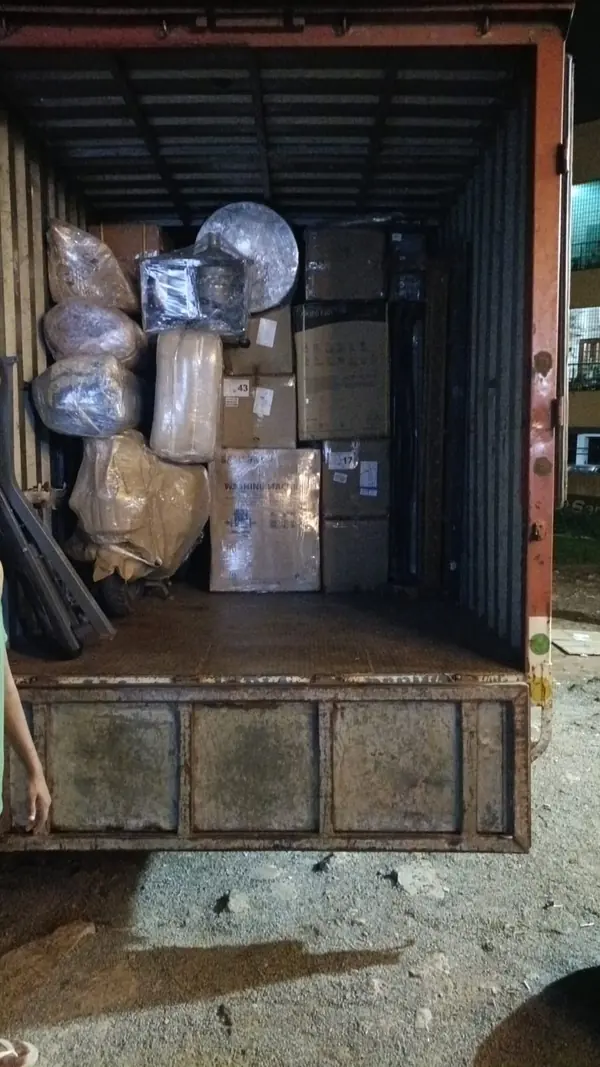
A household load rarely consists of boxes alone. This photograph includes upright wrapped pieces, cartons and a rounded item, each of which needs a place on the loading list. A room count will not give you that finished package count.
For your Goa move, number the sealed cartons and separately wrapped furniture before they leave the property. Link any detachable parts to the main item. Keep a note of what stays in the home, particularly when some furniture belongs to the rental owner.
Share the final list with the person receiving the goods. At unloading, check the numbers and visible condition together, and record any exception while the delivery team is present.
- Share both entrance pins, the inventory, photos of large or fragile pieces and preferred dates. Identify tenant goods, owner goods and any separately owned business equipment.
- Review the survey or inventory assessment, vehicle and crew arrangement, packing scope, lawful stopping points and any access work. Check dismantling, reassembly and unpacking explicitly.
- Approve one payable quotation and the payment milestones, cancellation or date-change terms. Confirm who receives the goods and whether keys and building access are ready.
- On packing day, review condition notes and actual package IDs. Keep medicines, valuables and essential documents with you. Declare restricted items; fuel, LPG cylinders and fireworks do not belong in a household load.
- Confirm the actual dispatch update and expected arrival window. For shared loads, allow for consolidation and other deliveries; ask who provides updates and how.
- At delivery, reconcile packages against the loading list, check visible condition and note discrepancies. Complete agreed placement, reassembly and unpacking; agree the collection of reusable materials or disposal of packing waste.
How to compare packers and movers in Goa
Directory listings make it easy to see many providers quickly, but a rating or a badge is not a quote. Whoever you shortlist, put the same questions to each of them and compare the written answers, not the phone impressions.
| Ask | Why it matters | A clear answer looks like |
|---|---|---|
| Is this a total or only a rate? | A per-box or per-hour rate is not a full move price. | A total for your inventory and both addresses, with inclusions listed. |
| Whose name is on the quote? | Jobs taken through brokers or listings can be passed to someone else. | The company name, GST registration and phone number of the party doing the work. |
| What vehicle body will be used? | Open and closed bodies behave very differently in rain. | Vehicle type stated, plus how wet-weather dates are handled. |
| How many people, doing what? | A vehicle alone is not a move. | Crew size and whether they pack, load, unload and carry. |
| What happens if the truck cannot reach the door? | Shuttle runs and long carries change the price and the timing. | Any shuttle or carry charge stated before the day. |
| What are the insurance terms? | Cover varies widely in what it pays for and when. | Who issues cover, what is covered, how declared value is set and how a claim is made. |
| What are the dispatch and arrival windows? | Shared loads may wait before they leave. | One window for dispatch and a separate one for road transit. |
| Which documents are issued, and will HR accept them? | Some employers reimburse only against specific papers. | A named list of documents, checked against your employer’s requirement. |
| How are extra items handled? | Moves grow on the day. | Any addition priced and approved by you before work continues. |
A mover who can answer every row in writing is easier to hold to the plan, whichever company you choose.
Why choose Agarwal ALPM for your Goa move
The business behind this page is Agarwal Logistics Packers and Movers, also trading as Agarwal (ALPM) Packers and Movers. Its GST registration is 36FDRPM0957B1ZC and its trademark registration number is 7901417. The registered office is in Old Bowenpally, Secunderabad. Several moving companies use the Agarwal name and they are not the same business, so check the GSTIN and trademark number on any quote instead of relying on the surname.
Goa moves are arranged through direct enquiry on +91 9467186002. Tell us the pickup address, the delivery address and what is moving, and we will confirm the crew, vehicle type, date and scope in writing before you commit.
Start with one agreed inventory, a named contact for the move and a scope that identifies packing, handling, vehicle arrangement and any work at the second address. That gives you something concrete to compare and check on moving day. A change in inventory or access should be priced and approved before the extra work starts.
Furnished rentals: your items and the owner’s items
Many rentals in Goa are let furnished or part-furnished. That means a mixed room can hold your things and the owner’s things side by side, and the movers should never have to guess which is which.
A simple ownership routine
- Before packing starts, photograph every room, including the inside of cupboards and any existing marks on walls and furniture.
- Make a photo schedule that marks each notable item as yours, the owner’s or something you will carry yourself.
- Give the schedule to whoever supervises the move and keep a copy.
- Have the owner or agent confirm the owner’s items and any existing damage, ideally in writing.
- On the last day, return keys and note meter readings so the handover is clear.
Illustration only: not a completed job
Imagine a tenant leaving a furnished flat in North Goa for a new lease in South Goa. The photo schedule has 18 inventory entries. Twelve entries belong to the tenant and are intended for the new home: a mattress, a bed frame in parts, a desk, an office chair, a bookshelf, a TV, a small fridge, a microwave, a floor fan, a shoe rack, and two sets of cartons for kitchen and clothes. Four belong to the owner, for example the sofa, the dining table, a wardrobe and a washing machine, so they are checked against the schedule and stay in the flat for the owner. Two are carried by the tenant personally: a bag with a laptop and a box of documents and valuables.
Only the 12 tenant inventory entries are assigned to the moving vehicle. This is not automatically 12 packages: a dismantled bed and a set of cartons can produce several separately numbered pieces. At packing, record the actual package IDs and total against those entries; compare that physical count at delivery. The four owner entries stay in the flat and the two personal entries travel with the tenant. Price the actual quantities and bulky pieces rather than assuming that an inventory with 12 entries is smaller than every 2 BHK load.
Vehicle only, labour plus vehicle, or full packing
Take the twelve tenant inventory entries from the example above and ask for three versions of the same move. The inventory stays the same; only who does the work changes.
| Option | What is provided | What you handle | Suits | Confirm in writing |
|---|---|---|---|---|
| Vehicle only | A vehicle and driver for the transfer from address to address. | Packing, loading, unloading and carrying. | Sturdy items that are already boxed and a helper at each end. | Whether the driver helps at all, and what happens if the vehicle cannot reach the door. |
| Labour plus vehicle | The vehicle plus people to load, carry and unload, with basic wrapping of furniture where agreed. | Boxing small items and loose belongings. | Furniture-heavy moves where the boxes are ready. | Crew size and exactly which wrapping is included. |
| Full packing | Packing materials and packing of items, then loading, transport and unloading. | Sorting, keeping valuables with you and arranging access at both ends. | Fragile or time-short moves. | What materials are counted, and whether unpacking is in or out. |
Access work must be accounted for in every option, including whether it is already included. If the vehicle cannot reach the door, any additional shuttle runs or longer carry are assessed, priced once and written into the quote. The same applies on the day: if a further item appears, it is added only when you agree both the item and the price, and the change is noted on the confirmation. That keeps the final bill predictable and keeps the loading list accurate.
Access in Goa: check the lane before choosing a vehicle
A Goa move can start on a wide main road and end at a house reached by a narrow lane, or the other way round. Older village lanes with boundary walls are the kind of place where we would want to look at the access before deciding, and areas such as Assagao, Siolim or Loutolim are examples of that, not rules. Plenty of addresses there will be fine and some in other places will not be, so it is a house-by-house question.
What to send us
- A map pin dropped on the actual entrance, not on the village centre or a landmark.
- Photos of the gate and the lane approaching it.
- The usable width of the gate and any turning space, low branches or cables on the way.
- The nearest place a truck can lawfully stop, and for how long.
- The carry distance from your door to that stopping point, in metres or a rough count of steps.
- The number of floors and whether a lift works.
Illustration only: a lane-access decision
Suppose a house has a gate that fits a small pickup but offers no turning space beyond it. A larger truck can stop lawfully at the junction on the main road, 150 metres away. There are three realistic ways to handle it. The crew can carry everything the 150 metres, if the crew assesses the route, load weight and handling as suitable; this can take considerable time for furniture. A small pickup can shuttle between the gate and the truck, and if the load needs four runs, the quote should allow for those runs, crew time and both transfer counts. Or, if the total volume is small, a smaller vehicle can do the whole job.
The choice depends on the number of runs and the carry distance, not on the name of the locality. The distances and runs here are examples. Whatever the answer, the quote should state the stopping point, the shuttle vehicle and the expected number of runs, and you should reconfirm access close to the date in case parked cars or a local event have changed the lane.
Monsoon moves: keep everything dry before it is wrapped
Goa’s climate is hot and humid, and the monsoon generally runs from early June to late September. For a move, that has two practical consequences: goods should be dry before they are wrapped, and the transfer from door to vehicle should be covered as far as possible.
A dry-state check before packing
- Make sure clothes, bedding, curtains and cushions are clean and fully dry before they are wrapped or boxed. Damp textiles sealed in a carton can turn musty.
- Defrost and dry the refrigerator before packing. Drain and dry the washing machine according to its manual; refit transit bolts where the model requires them. Keep doors open while drying, then secure them for handling.
- Wipe metal parts, tools and exposed fittings dry.
- Keep cartons and wrapped furniture off wet floors and off the ground while waiting to load.
Cover and vehicle
- Plan a sheltered path from the door to the vehicle, such as a porch, a parking shed or a temporary cover, and keep a few spare sheets ready.
- Ask for the vehicle body type in the quote. For monsoon dates, look at the roof and door seals when the vehicle arrives and say so if you see gaps.
- Ask what happens if heavy rain stops loading, and leave slack in your timeline for a pause between showers.
If something gets wet
If packaging gets wet, pause in a dry, sheltered place, record its condition and have the contents checked before repacking in dry material. Do not switch on damp electronics; follow the manufacturer’s instructions and seek qualified assessment if water may have entered.
Choose cushioning and surface protection for the piece: edge protection for furniture, supported cartons for crockery and suitable packaging for electronics. Stretch film is an outer layer, not a replacement for cushioning or drying. For an antique or delicate finish, discuss handling and materials before packing.
Seasonal residents and staged moves
Many people in Goa move on a calendar set by someone else: a lease that starts on a certain date, a landlord who hands over keys late, a season that begins or ends. A staged move works best when every date is written down.
- Match dates. Compare your vacating date with the date you get keys to the new place, and plan for any gap.
- Name a receiver. Someone must be at the delivery address to check items and sign. Give us their name and phone number.
- Pack a gap bag. Bedding, chargers, medicines, basic kitchen items and documents should stay with you and not go on the vehicle.
- Check whether holding is needed. If the new place is not ready, consider revising pickup or dispatch before loading. Delaying delivery after dispatch may still involve holding, handling or vehicle waiting.
- Agree holding terms. If goods must wait, the location, conditions and price are assessed and agreed in writing first, and you receive a list of exactly what is being held.
The same approach works in reverse for seasonal residents who close a property after the season and return months later. Retain the condition record, package count and custody details for the return move.
Goa addresses and areas: be precise
Goa is a small state, but pickups and deliveries are spread across many towns and villages. North Goa and South Goa are helpful ways to describe where you live, but a quote depends on the exact addresses. Two addresses within one town are a different job from a pickup and delivery at opposite ends of the state, so give both.
- Panaji and Panjim are the same city. So are Margao and Madgaon. Use whichever spelling you like, but add the locality, building name and a nearby landmark.
- Dabolim and Mopa are two separate airport areas. Do not enter an airport name as your home pin. Share the house or building address.
- If you are also moving equipment from a shop or workshop, for example in an industrial estate such as Verna or Kundaim, treat it as a separate list with its own address, its own inventory and permission from whoever controls that premises.
- Moves involving Mapusa, Margao, Vasco, Ponda or smaller villages should each carry a pin on the entrance, so that the crew finds the right gate first time.
Moving out of Goa: planning budgets by route
If you are leaving Goa, the table shows indicative planning ranges for a 2 BHK household to major cities. They are for budgeting only; the Delhi, Bangalore, Ahmedabad and Kolkata rows explicitly separate shared and dedicated transport. A route quote for your actual addresses and inventory governs. For a 1 BHK or a larger home, ask for a route quote.
| Destination | Indicative 2 BHK total |
|---|---|
| Pune | Rs. 17,000 to Rs. 24,000 |
| Mumbai | Rs. 18,500 to Rs. 26,000 |
| Bangalore | Shared Rs. 24,000–34,500; dedicated Rs. 34,500–47,500 |
| Hyderabad | Rs. 20,000 to Rs. 28,500 |
| Delhi | Shared Rs. 28,000–38,000; dedicated Rs. 42,000–55,000 |
| Chennai | Rs. 18,000 to Rs. 28,000 |
| Ahmedabad | Shared Rs. 22,500–29,000; dedicated Rs. 34,000–44,000 |
| Kolkata | Shared Rs. 19,000–32,000; dedicated Rs. 36,000–48,000 |
Use the individual route guide for road distance and an indicative transit window, then confirm the loaded vehicle’s route and delivery plan for your own addresses. A Panaji pickup and a Canacona pickup are different starting points; the city name alone does not fix the driving distance.
Shared or dedicated vehicle
A shared load travels with other consignments and may wait at the start until the vehicle is filled. A dedicated vehicle carries only your goods and is planned for an agreed dispatch date, subject to vehicle availability and acceptance. Ask which arrangement your quote is based on, because the two are not like for like on price. Also ask for two separate windows: dispatch (when the vehicle leaves) and road transit (how long it travels). Waiting for dispatch is not part of transit, and mixing them up is how a promised short move turns into a long one.
Car and bike transport from Goa
Cars and bikes are priced separately from household goods, and the price depends on where the vehicle is going. The ranges below are planning ranges for budgeting. They are set from market examples reviewed for this page and are not fixed Agarwal ALPM tariffs, so your written quote is the figure that counts.
| Vehicle | Within Goa, one pickup and one drop | Intercity guide, approximately 300–500 km | Longer routes |
|---|---|---|---|
| Bike | Rs. 3,500 to Rs. 7,000 | Rs. 7,000 to Rs. 10,500 | Quoted per route |
| Car | Rs. 8,500 to Rs. 11,500 | Rs. 12,000 to Rs. 15,000 | Quoted per route |
Local vehicle transport can carry a minimum vehicle-allocation charge; it is a different service from hiring someone to drive the car. The intercity column is a short-distance budget guide, not a tariff for every destination in Maharashtra or Karnataka. The ranges assume an ordinary bike or car in running, transportable condition, with no modifications. A larger SUV, heavy cruiser, EV, modified or non-running vehicle needs individual acceptance and pricing. Open or enclosed carrier, collection and final handover points must be agreed; a closed carrier is not automatic.
What the quote should say
- How the vehicle travels, and from which point to which point. If a carrier cannot reach your lane, the handover point should be named.
- Whether the vehicle is booked alone or alongside a household move.
- What cover applies to the vehicle during transit, and who issues it.
- The dispatch and arrival windows, kept separate.
Handover checklist
- Photograph all sides of the vehicle with the date visible, and note existing marks.
- Record fuel or battery charge and the odometer reading; follow the actual carrier’s and manufacturer’s preparation instructions.
- Remove personal items and valuables from the car or bike.
- Keep RC and insurance copies and a photo ID ready, and ask what else is needed.
- At delivery, inspect the vehicle before you sign and note any issue on the paper.
Documents, delivery and claims
Before the move
Ask for a written quote showing addresses, the inventory summary, scope, price and exclusions. Confirm the date and who is attending. If your employer reimburses relocation, ask HR which papers it accepts and share that with us before booking, so we can tell you what we can issue and in whose name.
On the day
Check the loading list against what is actually being loaded, and sign only when it matches. Photograph high-value items and keep jewellery, cash, passports, original property papers, medicines and hard drives with you.
At delivery
Count the items against the list before you sign. Open priority cartons and check the furniture you can inspect straight away. If something is missing or damaged, note it on the delivery paper, photograph it and tell us in writing without delay.
Claims and insurance
What can be claimed depends on the terms you agreed at booking and any cover that was arranged. Before you book, ask who issues the cover, what it covers, how declared value is set, what proof is needed and how long you have to report an issue, the applicable exclusions and any excess. Confirm the insurer/provider and policy details before paying a premium. Insurance help is something to ask about at enquiry, not at the delivery door.
Practical checklist and common mistakes
Checklist
- Decide exactly what is moving and take photos of the main items.
- Send the pickup and delivery pins, floors and lift details.
- Check the lane: gate width, turning space, lawful stopping point and carry distance.
- If the home is furnished, mark which items are the owner’s.
- Ask for a written quote with scope, crew, vehicle type, access charges and exclusions.
- Confirm the date, the arrival window and who will be present at each end.
- In monsoon months, dry textiles and appliances and plan a covered path to the vehicle.
- Keep valuables, documents and a gap bag with you.
- Check the count against the list before signing at delivery.
Common mistakes
- Comparing a per-box or per-hour rate with a total price.
- Giving a village centre or an airport name as the pickup pin.
- Assuming a truck can reach the door without checking.
- Letting owner-supplied furniture get mixed into your inventory.
- Booking a move too tightly against key handover dates.
- Sealing damp textiles or cartons in the rush to finish.
- Accepting verbal changes on the day without a written note.
- Having nobody at the delivery address to receive and check.