

On this page — view sections
Mumbai Pune shifting charges: indicative planning budgets
These are indicative planning budgets for moves from the Mumbai region to Pune or Pimpri Chinchwad. They are not a published tariff, a market average or an invoice. Your written quote depends on your actual inventory, both addresses, the mode and the extras you choose, so use the ranges to sense-check a quote rather than to predict it to the rupee.
| Move size | Indicative budget (₹) | What usually decides where you land |
|---|---|---|
| Few items | 5,500–9,500 | Number of cartons and pieces, carry distance, shared or dedicated |
| 1RK | 6,500–13,500 | Bed and wardrobe handling, floor, lift access |
| 1BHK | 8,500–18,500 | Furniture volume, appliances, stairs or long carry |
| 2BHK | 15,500–25,500 | Furniture to dismantle, amount of packing, parking distance |
| 3BHK | 19,500–31,500 | Inventory size, fragile items, access at both ends |
| 4BHK | 28,500–42,500 | Volume, heavy pieces, crew hours needed |
| Villa | 34,500–56,500 | Multiple floors, outdoor items, carry distances |
| Larger homes | Individually quoted | Detailed inventory or a visit before pricing |
What the budget covers
Each range assumes the basic scope: packing, loading, transit and unloading. Dismantling and assembly, crates, technicians, tolls, parking, stairs, long carry, waiting time, storage, redelivery, GST and optional transit cover are separate lines, and none of them is assumed inside the range. Please do not read any figure here as all-inclusive.
How to read a quote against these ranges
- Check that the quote names the mode, dedicated or shared. A dedicated vehicle is priced separately for the same inventory, so the two are not directly comparable.
- Check that the inventory in the quote matches yours item for item.
- Look for each extra marked in writing as included or extra.
- If a figure sits outside the range, ask what is driving it. A long carry, a walk-up building or a lot of assembly can explain a lot.
Extras to confirm in writing
A missing task or access detail can make two moving quotes look more similar than they are. Before you accept a quote, have each line below marked as included or extra.
| Item | Why it moves the price | What to ask for in writing |
|---|---|---|
| Dismantling and assembly | Beds, wardrobes and modular units take crew time at both ends | Which pieces, who does it, included or extra |
| Crates and technicians | Some appliances, televisions and delicate items may need crating or a technician to uninstall and reinstall | Who uninstalls and installs, and whether crates are supplied |
| Tolls | Road charges vary with the route a vehicle takes | Whether tolls are in the figure or billed separately; do not assume a toll count |
| Parking and entry | A society or a site may charge for vehicle entry or parking | Who pays and any amount known in advance |
| Stairs and long carry | More crew time when there is no lift or the vehicle cannot stop close | Floors without a lift and the approximate walk from vehicle to door |
| Waiting time | Delays at a gate, a lift or a receiver hold up the vehicle and crew | What counts as waiting and how it is charged |
| Storage and redelivery | Needed if goods cannot be received on the agreed day | Where goods wait, for how long and what redelivery costs |
| GST | Quotes may be stated before or after tax | Whether tax is included or added |
| Optional transit cover | Cost depends on declared value and policy terms | Whether it is offered, who issues it, the declared value and the cost |
Dedicated, shared and part load: choosing the mode
The mode changes both price and timing, so it should be named in every quote.
| Mode | Best suited to | Timing guide | What to check |
|---|---|---|---|
| Dedicated vehicle | Full homes, mixed furniture and appliances, a fixed receiving window | Preliminary 1–2 days after dispatch; same-day only when the conditions in the same-day section are met | Mode named in the quote and priced separately for the same inventory |
| Shared or part load | Few items, student moves, a small room's worth of goods | 2–3 days from pickup, including consolidation | The delivery date is a range, so the Pune receiver needs flexibility |
| Separate car or bike carrier | Cars and two-wheelers | 2–4 days from pickup, subject to carrier availability | Timing is separate from the household goods |
Why shared usually costs less
In a part load Mumbai Pune arrangement your goods travel with other consignments, so you pay for the space you use. The trade-off is time: loads are consolidated before they move, which is why the clock runs from pickup rather than from dispatch. A shared figure and a dedicated figure for the same inventory are different products, not a cheap and an expensive quote for the same service.
Questions for a part-load quote
- How is the volume counted: cartons, pieces or space?
- Can the goods be delivered on any day in the stated range, or only on specific days?
- Who receives at Pune, and what happens if nobody is there?
- Is storage or redelivery written in as an extra?
An app-booked tempo, or a moving quote?
Compare the service selected, not only the booking channel. An app can offer different products, so check whether the fare you are viewing is vehicle transport or an assessed packing-and-moving service. Confirm who packs, carries from the Mumbai flat, loads, secures the goods and unloads at the Pune property. Add separately hired labour, materials and any agreed furniture work before comparing totals.
Ask how waiting is handled if the Mumbai lift slot or Pune gate opens late, and whether the booking is accepted for your actual intercity destination. For the same inventory, compare the complete scope and receiving window. Do not assume a vehicle-and-driver booking includes floor carrying, or that every app moving package excludes it.
Mumbai Pune distance and moving time
For planning, use a road distance of 150–220 km. This is a rough guide rather than a limit: exact Mumbai-region and Pune or Pimpri Chinchwad endpoints, as well as commercial routing, can produce a longer or shorter journey. As a passenger-car reference, Google Maps shows 149 km and about 2 hours 39 minutes via the Mumbai–Pune (Yashwantrao Chavan) Expressway toll route. That figure is not a goods completion time and not a fixed highway promise. A loaded vehicle, waits at buildings and traffic all change the day.
What a moving day is made of
- Packing at the Mumbai address, which depends on how much is already boxed.
- Loading, which depends on lifts, stairs and the walk to the vehicle.
- Waiting for society permission, a lift slot or a receiver.
- The road leg, which is only one block of the day.
- Unloading and placing furniture at Pune, with time allowed for the actual floor, lift and carry distance.
- A buffer for the unexpected.
How long the goods take after the vehicle leaves depends on the mode, as the table above shows. For working out a delivery day from the Pune end, use the backward plan further down.
Same day Mumbai Pune relocation: when it can work
A same-day move means the whole job, from first box to last placed carton, finishes inside the hours both buildings allow. We only say yes after four things are assessed: the itemised inventory, access at both addresses, realistic packing time and both receiving windows. Even then it is a plan with a buffer, never a 100% promise.
Signs it is realistic
- The inventory is modest and mostly packed or quick to pack.
- The Mumbai building allows goods work early enough in the day.
- The Pune property allows unloading to finish late enough, and a receiver with keys will be there.
- Lifts, parking and gate entry are arranged at both ends.
- There is little dismantling or assembly, and a dedicated vehicle is booked.
Signs to plan for two days
- A large inventory or many fragile items that need careful packing.
- A Mumbai building that allows goods work only from mid-morning.
- A Pune society that allows only a short unloading window.
- Walk-ups, long carries or heavy items at either end.
- A car or bike moving separately, or a shared load.
If your move lands in the second list, that is not a failure. It just means a planned two-day schedule will serve you better than a rushed one-day attempt.
Pickup and delivery planning: exact addresses matter
Mumbai to Pune is not one pickup and one drop. A Thane flat and a Vasai–Virar flat start from different places, and a drop at Wakad, Baner or Hinjawadi is a different job from a drop at Kharadi or Hadapsar. Treat each as an exact address, not a universal rule: do not assume two Pune areas share the same road approach, exit or fee. Give the complete Pune or Pimpri Chinchwad destination: area, project, tower or wing, flat, PIN and the entrance used for goods. Confirm the actual gate location so the carrier can plan the approach.
What we need for the Mumbai end
- Floor, whether a lift works, and whether a goods lift can be booked.
- Whether the society needs permission for a shifting vehicle and when goods work is allowed.
- How close the vehicle can park and whether lanes are narrow.
- Who is present to hand over keys and sign the inventory.
What we need for the Pune end
- The project name, tower or wing, floor and the gate used by goods vehicles.
- The latest time unloading can finish at that property.
- Whether a lift can be booked and whether society permission or a deposit applies.
- Who receives the goods, and whether the home is ready for them (cleaned, keys, power).
These answers decide vehicle size, crew size and timing. They also feed directly into the backward plan below.
Pune city, PCMC, or another named endpoint?
Lonavala, Talegaon-Dabhade and Chakan are separately listed municipal councils in Pune district. If that is your destination, name the town rather than assuming a Pune city quote covers it. Within the wider Pune region, give the actual locality and PIN for a Wagholi, Maan, Undri–Pisoli or other address as well; an area label alone does not identify the final gate, approach or carrying work.
For an office in an IT park or company campus, ask its facility or security contact which goods entrance is usable, what receiving window is available and whether any crew or vehicle details need submitting. Pass the confirmed answer to the coordinator and use the actual latest unloading time in the backward plan.
A backward receiving-window plan for Pune
Most people plan a move forwards: pick a start time and hope the end works out. A more useful way is to start from the one hard limit, the latest time the Pune property will let unloading be completed, and work back from there. Ask for the completion time, not an arrival time.
The method
- Ask the Pune society or owner for the latest unloading completion time at your actual property.
- Subtract an unloading and placement budget.
- Subtract a buffer.
- Subtract a road allowance. This is a planning allowance, not a guaranteed drive time.
- Subtract loading time.
- Subtract packing time.
- The clock time you reach is the crew start target. Compare it with the Mumbai building's earliest goods-work time.
Worked example (hypothetical only)
| Step | Subtract | Clock time reached |
|---|---|---|
| Latest unloading finish at Pune | Start point | 18:00 |
| Unloading and placement | 2 hours | 16:00 |
| Buffer | 1 hour | 15:00 |
| Road allowance | 4 hours | 11:00 |
| Loading | 1 hour | 10:00 |
| Packing | 3 hours | 07:00 crew start target |
This is an illustration, not an actual trip. The hours are not guaranteed drive times, and the plan is not permission to push for early entry into a society. Real figures come from your inventory and your two buildings.
If the Mumbai window starts later
Suppose the Mumbai building allows goods work only from 09:00. The 07:00 start is then out of reach, and the same sums run forward to a 20:00 finish, two hours after the 18:00 limit. A same-day finish cannot be promised in that case. The options are packing the day before if the building and you allow it, agreeing next-day receiving at Pune, or another plan we have assessed with you. Reconfirm the actual building windows, keys and receiver at both ends close to the date, because there are no universal Pune rules to lean on.
Using the plan for a wet-weather moving day
If rain is expected on your moving day, reassess the stage allowances and buffer rather than changing the method. An exposed carry, covered staging or pauses during heavy showers can affect packing, loading and unloading. Ask for assessed allowances for your properties instead of treating the illustrative 1 hour as sufficient for every move, and ask at the survey how sofas, mattresses and cartons will be protected between the door and the vehicle at both ends. If the bigger buffer pushes the start time before your Mumbai building opens, plan on packing the day before or on next-day receiving, exactly as the section above suggests.
House shifting Mumbai Pune: full-home moves
For house shifting Mumbai Pune, the scope is packing, loading, transit and unloading of your household goods, with furniture handling agreed in advance. What makes it work is the inventory, not the distance.
Build a room-by-room inventory
List furniture, appliances, cartons you pack yourself and items we will pack. Mark anything fragile, oversized or awkward on stairs. Note which pieces need dismantling. The more specific the list, the closer the quote is to the final bill.
Agree who packs what
Decide whether the crew packs everything, only kitchen and fragile items, or only the furniture. Write down the materials for fragile and electronic items rather than assuming them.
Loading and transit
Heavy pieces should be planned first so the load is stable, with boxes labelled by destination room. The vehicle and window are agreed in the quote, and any change is told to you rather than discovered at the door.
Unloading and handover count
On arrival, goods are placed as you direct and the count of cartons and furniture pieces is checked against the inventory taken at loading. Note anything missing or damaged on the handover sheet at the time, before the crew leaves.
Packing, fragile items and furniture assembly
Pack the mattress for the carry, not just the drive
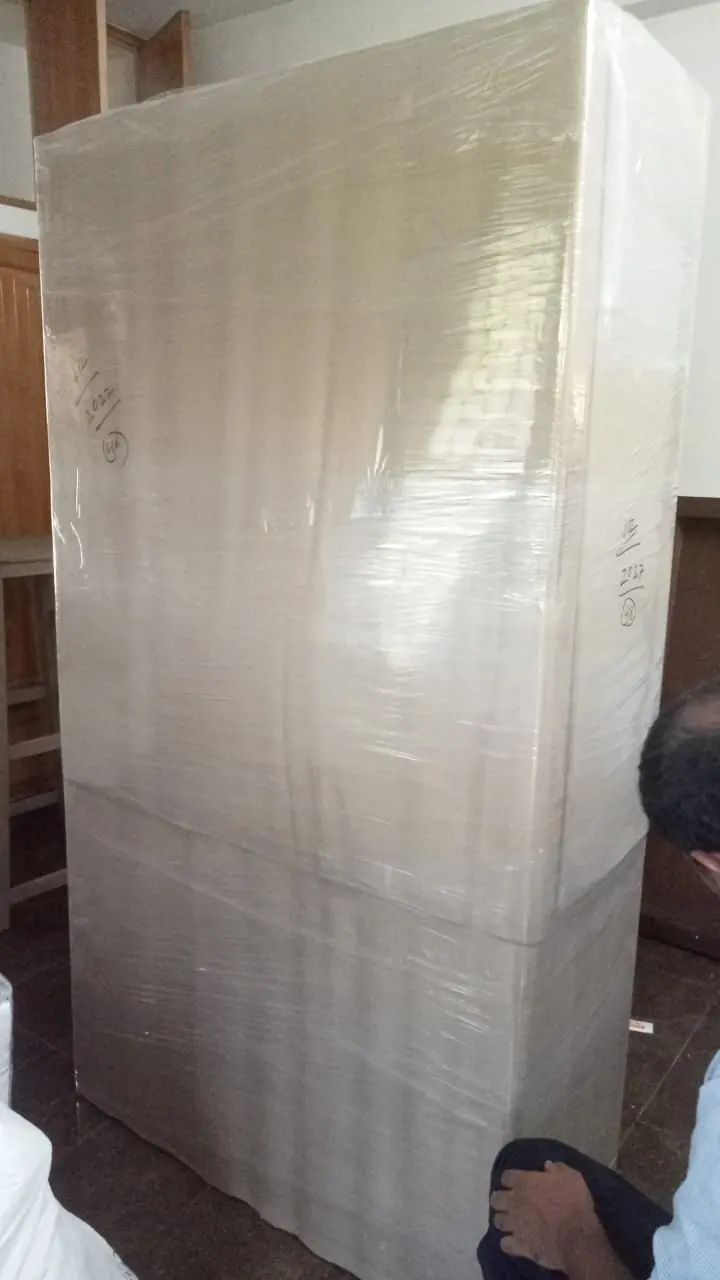
A short intercity journey still includes doorways, a loading point and an unloading carry. The mattress in this photo is covered before it leaves the room, which is where its protection needs to start.
For Mumbai to Pune shifting, share the mattress dimensions and any maker's restrictions on bending it. Check both the bedroom exit and the Pune lift entrance. Ask how the corners and bottom edge will stay covered while the mattress is being carried.
Decide its destination room in advance. Open the wrapping there once the carry is finished, keeping the discarded material clear of the unloading path.
Packing responsibility
An agreed packing list helps the crew bring suitable materials and helps you prepare what stays with you. Decide before booking what is packed by the crew, what you pack yourself and what you will carry yourself. Anything you pack yourself should be listed as your own packing on the inventory.
Fragile items and electronics
Glassware, mirrors, framed art, televisions and computers need individual attention. Ask what protection each gets, and whether original boxes are available. Keep cables and remote controls together in a labelled bag; keep account credentials securely with you so setup at Pune does not turn into a search.
Dismantling and reassembly
Beds, wardrobes, dining tables and modular units may need to come apart for stairs or lifts and go back together at the other end. Agree which pieces, who does the work and whether it is included or an extra. Wall-mounted items, curtains rods and fitted units usually need a technician or carpenter, so plan that separately.
Appliances
Washing machines, refrigerators and air conditioners have specific preparation needs, as set out in their manuals, including any required draining, transport restraints or defrosting, and uninstalling or installing an air conditioner is usually a technician's job. Ask who handles each step so nothing falls between the crew and you.
Few items, students and part load Mumbai Pune
For a student with a bed, boxes and a bicycle, or a household sending a few furniture pieces, compare shared space with a small dedicated vehicle before choosing. The indicative planning budget for a few items is ₹5,500–₹9,500, and the 1RK budget is ₹6,500–₹13,500, with shared or dedicated mode named in the quote.
What helps keep the figure down
- Pack in uniform cartons that stack, and label each with name and room.
- Send a short list with sizes, not just a count, so volume is clear.
- Choose a shared load if your date has room, remembering the 2–3 days from pickup that it takes.
- Say if the Pune address is a hostel, PG or a flat with limited entry times.
Hostel and PG moves
Gate staff may allow vehicles only at certain hours or need a name on a list. Give us the exact gate, the hours and a contact who can receive. If nobody can receive in the window, discuss storage and redelivery before the day rather than on it.
If your volume grows beyond a few items, tell us early. A small dedicated vehicle with a defined window can be a better fit than a shared load that waits to fill.
Office relocation Mumbai Pune for small offices
For small physical offices, an indicative planning budget is ₹18,500–₹35,500. That figure assumes about 6–8 workstations, chairs, computers, a few cabinets and files, and it covers physical goods only. IT backup and reconnection are excluded from this physical-goods service. Stock and machinery need their own assessment.
| Assumed in the budget | Handled separately |
|---|---|
| 6–8 workstations and chairs | IT backup and data safety |
| Computers and monitors moved as physical items | Reconnecting networks, servers and phones |
| A few cabinets and files | Stock, inventory for sale and machinery |
| Basic pack, load, transit and unload | Assembly, crates, technicians, tolls, parking, stairs, waiting time, storage and GST as written in the quote |
Plan it like a house move with extra labels
- Number each workstation and tag cables, monitors and cartons with the same number.
- Prepare a floor plan for the Pune office so desks go where they belong.
- Ask the Mumbai building and the Pune building for their goods-movement hours, and use the backward plan to fit them.
- Move sensitive files with someone from your team rather than in a general load.
Your IT person should back up data before the move and handle reconnection afterwards. We handle the physical goods, as scoped in your quote.
Car transport and bike shifting Mumbai Pune
Confirm whether a car or bike uses a separate carrier schedule from your household goods. The indicative planning budgets are below, and the timing guide is 2–4 days from pickup, subject to carrier availability.
| Vehicle | Indicative budget (₹) |
|---|---|
| Hatchback | 6,500–10,500 |
| Sedan | 8,500–12,500 |
| SUV | 10,500–15,500 |
| Bike | 3,000–6,000 |
| Heavy bike | 5,500–8,500 |
Before pickup
- Keep the registration certificate, insurance papers and an identity proof handy, as carriers commonly ask for them.
- Take dated photos of every side, the odometer and any existing scratches.
- Agree fuel preparation and keys with the carrier; remove loose items and personal documents.
- Note the car's size and any modifications, because they can change the carrier that can take it.
At handover in Pune
Check the vehicle against your photos before signing. Record any new marks on the receipt in the presence of the person delivering. If you are also moving household goods, confirm its arrival window separately and arrange the Pune receiver for that window.
Storage, redelivery and transit cover
Storage and redelivery
Sometimes the new home is not ready, or the society does not allow unloading on the day. Storage and redelivery are optional services scoped in writing. Ask where the goods are kept, for how long, how the inventory is recorded while they wait, and what redelivery will cost. Fix those answers before the day so a delay does not become a negotiation at the door.
Optional transit cover
Goods in transit can be covered by an optional policy, and we help with that as scoped. Cover is not automatic. The cost depends on the declared value and the policy's terms, and we do not quote a flat percentage. Ask who issues the policy, what it covers and excludes, what value you need to declare and what documents are needed for a claim. Keep photographs of high-value items and invoices where you have them.
The quote should say plainly whether cover is included or extra. If you choose not to take it, ask for that to be recorded too.
Why book this route with Agarwal Logistics
You deal with the business directly, through the contact preparing your moving quote. Four practices shape how a Mumbai–Pune move is handled:
- Itemised inventory and access: your inventory and the access details at both addresses go into the scope before a price is fixed.
- Agreed transport and window: the vehicle, the mode and the time window are stated in the quote, not left to be worked out on the day.
- Handover count: cartons and furniture are counted against the inventory at loading and again at unloading.
- Plain scope: what is included and what is extra is written down line by line.
Business details: Agarwal Logistics Packers and Movers, also known as Agarwal (ALPM) Packers and Movers. Mumbai-region contact: Shop 10, Omkareshwar Apartment, Rewale Talavo, Thane 400607. Phone +91 94671 86002. Email info@agarwalpackermoverindia.com. GST 36FDRPM0957B1ZC, trademark 7901417, Udyam UDYAM-TS-02-0069425. We are independent of similarly named companies.
How to choose a mover for Mumbai to Pune
Whichever company you use, a few checks keep the comparison fair.
- Give every company the same inventory, the same two addresses and the same date, or the quotes cannot be compared.
- Ask each one to name the mode and the vehicle, and what they mean by dedicated or shared.
- Ask for scope in writing: what is packed, what is dismantled, what is unloaded and placed.
- Ask for each extra from the extras list to be marked as included or extra.
- Ask what they need from the Pune receiver and whether they plan from the latest unloading time.
- Ask how handover will be counted, and who signs.
- Be careful with any figure that is far below the others and cannot be explained by scope or mode.
A good answer is specific. A vague reassurance on same-day delivery, with no questions about your buildings, is a reason to ask more.
How booking works, step by step
- Send your inventory, both full addresses and your preferred date by phone or email, with photos of bulky or awkward items if you can.
- Share access details: floors, lifts, parking, goods-work hours and who will be present at each end.
- Receive a written quote that names the mode, the vehicle and the window, and marks each extra as included or extra.
- Fix the plan with the backward receiving-window method, or choose a two-day schedule if the numbers do not fit.
- Confirm the date and the scope in writing.
- On the day, the crew packs and loads against the inventory and records the count.
- At Pune, goods are unloaded and placed, the count is checked and the handover sheet is signed.
Agree the assessed pickup and delivery window before confirming; update the plan if inventory or building access changes.
Moving-week checklists
Before packing day
- Confirm goods-work hours and lift booking at the Mumbai building.
- Confirm the latest unloading completion time and gate at Pune.
- Finalise the inventory and note fragile and bulky items.
- Prepare appliances according to their manuals and arrange technicians for agreed disconnection work.
- Pack valuables, documents and medicines to carry yourself.
On pickup day
- Be present or name someone to hand over keys and sign the inventory.
- Walk each room with the crew before loading and after.
- Check the carton and furniture count against the inventory before the vehicle leaves.
- Keep your phone on and share the Pune receiver's contact number.
On delivery day
- Have the receiver ready with keys, lift booking and gate permission.
- Check the count on arrival, and open cartons marked fragile before the crew leaves if you can.
- Note any missing or damaged item on the handover sheet at that time.
- Confirm any extras that arose on the day before paying.
Common mistakes on a short intercity move
- Assuming a 150 km route means a one-day move. The road leg is one part of the day, and the buildings often decide the rest.
- Comparing a shared quote with a dedicated one as if they were the same service.
- Giving only Pune as the destination, without the project, tower, gate or whether it is a Pune or Pimpri Chinchwad address.
- Asking for an arrival time instead of the latest unloading completion time.
- Not booking the lift or checking society permission at either end.
- Leaving assembly, crates, technicians or storage out of the written scope.
- Forgetting that cars and bikes usually move separately from household goods.
- Skipping the handover count, then trying to reconstruct what is missing days later.
- Packing valuables, documents and medicines into the load instead of carrying them.
Advance booking, cancellations and date changes
A date matters on this route because a vehicle, a crew and two building windows are lined up around it. Tell us early if anything is likely to move, such as a society permission, a lift slot, a lease handover or a possession date.
Things to settle before you confirm
- How far in advance the date should be confirmed.
- What happens if your date changes, and how much notice is needed.
- Any charge for cancelling, and when it starts to apply.
- What happens if the Pune building will not allow unloading on the day, including storage and redelivery.
Ask for these terms in writing along with the quote. We do not publish a one-size cancellation rule here, because it depends on the mode, the vehicle and how much has been arranged. Whatever is agreed should be on paper before the day, not discovered on it.