

Packers and Movers Pune to Varanasi: Charges, Route and Delivery
Pune to Varanasi is around 1,490 km by the primary driving reference. The general 2 BHK household guide is ₹23,000–33,000. Plan on 4–6 days after actual dispatch for a dedicated truck or 7–9 days for a shared load, with packing and consolidation before departure. Confirm the exact home or campus receiving address before booking.
Pune to Varanasi moving overview
| Road distance | Around 1,490 km primary driving planning guide; actual truck route confirmed |
| 2 BHK household budget | ₹23,000–33,000 general moving guide; confirm mode, scope and final total |
| Transit after dispatch | Dedicated 4–6 days / shared 7–9 days planning guides; packing and consolidation extra |
| Exact destination | Confirm Varanasi home or actual BHU campus/residence; South Campus near Mirzapur is a separate endpoint |
| Receiving plan | Named receiver, permission, usable entrance and separate personal/institution-owned inventory |
Get Free Quote
On this pageView sections
Pune to Varanasi shifting charges: household planning guides
The table below shows general household budget guides for moving from Pune to Varanasi. Treat the figures as a way to check whether a quote is in a sensible range, not as the price of your move. A 2 BHK with a lift at both ends and a light inventory can land low in its range, while the same 2 BHK with heavy furniture on an upper floor without a lift can sit near the top.
| Home size | Planning budget guide |
|---|---|
| 1 BHK | ₹14,000–₹22,000 |
| 2 BHK | ₹23,000–₹33,000 |
| 3 BHK | ₹32,000–₹48,000 |
| 4 BHK | ₹45,000–₹65,000 and above |
These ranges describe a household move as a whole, based on the standard scope of packing, loading, transport and unloading. They are not split into separate shared-truck and dedicated-truck prices, and they are not a packing-only fee. Whether your goods suit a shared load or need a truck to themselves is decided when the inventory is reviewed, and the written quote states the actual work included and the final total.
A BHK label is only a starting point. Two 3 BHK homes can differ by a large margin in volume, so the number of cartons, the furniture list and the access details matter more than the room count. Crates for fragile or oversized pieces, a crew size larger than the BHK suggests, and extra carry distance are decided from your inventory, not assumed from the home size.
How to compare quotes for a Pune to Varanasi move
Two quotes for the same move can look far apart because they describe different work. Before you compare totals, compare scope. A written quote that you can rely on should say what is being packed and by whom, what material is used, how the goods are loaded, how they travel, who unloads at Varanasi and whether goods are placed inside the home or left at the vehicle.
Confirm inclusions and additional work
- Crating for fragile, glass-top or oversized pieces.
- Technician work such as removing and refitting air conditioners, geysers or network equipment.
- Dismantling and reassembling beds, wardrobes or modular furniture.
- Extra carry when the vehicle cannot stand near the building or when there are many stair flights.
- Applicable tax, tolls and any optional transit cover.
- Holding of goods at a named location if the receiving date or room is not ready.
Each of these should appear once, in writing, before loading begins, so you can compare like with like and the total is not rebuilt after the truck is loaded. Before comparing a preliminary total, ask which floors, lifts, carry distances and service inclusions it assumes. Mark each item as included, additional with an amount, or not applicable, and count it once.
Also compare how much the company asked you. A provider that wants to know your floor, lift, parking space for a truck and the exact delivery address is building the quote from your real conditions. A preliminary BHK estimate should be refined against the actual inventory and access before booking.
Pune to Varanasi distance and route
When this page was prepared in October 2026, driving directions between Pune and Varanasi showed three options. Use around 1,490 km as the planning figure for a household move.
| Route option | Driving distance |
|---|---|
| Via the Maharashtra Samruddhi Mahamarg (primary option shown) | 1,487 km |
| Via the Samruddhi Mahamarg and NH30 | 1,410 km |
| Via NH347 | 1,538 km |
The shortest map distance is not automatically the corridor a loaded goods vehicle takes. Truck routes are chosen for road condition, vehicle size, tolls and driver rest, so the operator confirms the route for your loaded vehicle. Check the route’s suitability near dispatch; changed road conditions or access can alter the actual corridor and distance.
Travel times you see for a passenger car or train describe a different kind of trip. A loaded goods vehicle covers the distance on its own schedule, and the number of days that matters to you includes the packing, loading and consolidation that happen before departure, which the next section sets out.
Delivery time: dedicated truck, shared truck and part load
Delivery time for a Pune to Varanasi household move depends on how your goods travel. The figures below are planning guides that begin after actual dispatch, when the loaded vehicle actually leaves Pune. Packing, loading and shared consolidation happen before that starting point.
| Type of move | Planning guide |
|---|---|
| Household goods in a dedicated truck | 4–6 days |
| Household goods in a shared truck | 7–9 days |
| Bike on a separately planned carrier | 5–7 days |
| Car on a separately planned carrier | 4–6 days |
Dedicated, shared and part load
A dedicated truck carries only your goods, so it can leave once your packing and loading are complete. A shared truck, often called a part load, carries your goods together with other customers’ consignments. That can suit a 1 BHK, a few cartons or a set of student belongings, but the truck waits for the load to be consolidated, which is why the guide is longer and why consolidation time sits before the road days.
As an illustration only, suppose loading finishes on the 10th and the truck actually dispatches on the 11th. A dedicated-truck guide would point to arrival around the 15th to the 17th, while a shared-truck guide would point to around the 18th to the 20th. Add the days it takes to pack and load in Pune, and keep the receiving person’s availability in mind, since a delivery that arrives when nobody can receive it creates its own delay.
Vehicles usually travel on a separate carrier, so a car or bike handover is planned and confirmed on its own schedule rather than arriving with the household truck.
Reconfirm the receiving appointments when the arrival window changes
If your Varanasi move overlaps Sawan, ask the operator to check the current traffic arrangements for the selected delivery approach and have the receiver confirm the usable goods entrance. A temple-area arrangement does not by itself establish the rules for a BHU residence, another city locality or South Campus near Mirzapur. In foggy conditions, use current highway warnings and the operator’s revised arrival window rather than automatically adding one day to every booking.
Update the receiving plan for each inventory group separately. In the example below, the person authorised to receive 3 institution assets may have a different appointment from the person receiving 12 personal cartons. If a revised truck arrival misses either appointment, obtain a new authorised receiver or agree accepted waiting or holding for that group before changing delivery instructions. Do not leave institution assets with a household backup contact merely because that person can receive your own cartons. Keep joining papers, medicines and immediate study needs with you so a revised goods appointment does not prevent you attending your own joining or admission appointment.
Varanasi or Banaras: confirm the destination first
Varanasi and Banaras are two names for the same city, and many people use them interchangeably, along with Kashi. For a mover, though, the useful question is not the city name. It is the exact place where the vehicle will stop and the goods will be handed over.
Three very different destinations can all be described as ‘Varanasi’. The first is a flat or house in the city, where the building, society gate, floor and lift decide the work. The second is a hostel, staff quarter or allotted residence on the Banaras Hindu University main campus. The third is Rajiv Gandhi South Campus, which BHU’s own How to Reach page places about 8 km south-west of Mirzapur on the Robertsganj highway. That is a separate delivery destination, not an address on the main campus in Varanasi, and the route, receiving arrangement and quote are written for the address that applies.
A department or institute postal address is often written on letters and forms, but it is not necessarily the place where household goods can be received. What the crew needs is the allotted residence, hostel, quarter or building, along with the gate that can actually be used. ALPM is an independent moving business, so rules about vehicle entry and receiving at any institution are set by that institution and have to be confirmed by you.
Settle the destination before you pay for packing. A change of address after loading can alter the route, the days and the cost, and it is far easier to correct on paper than on the road.
BHU main campus and Rajiv Gandhi South Campus: what to settle before dispatch
If your goods are going to a BHU address, whether you are a student, a researcher or an employee, agree the following details in writing before the truck leaves Pune. The same checklist works for any gated campus or large residential complex.
| Detail | What to confirm |
|---|---|
| Exact delivery point | The allotted residence, hostel, quarter or building, not only the department address |
| Campus | Main campus in Varanasi or Rajiv Gandhi South Campus near Mirzapur |
| Entry permission | Whether a goods vehicle may enter, and any permission or timing the institution requires |
| Receiving window | The date and hours when someone can receive the goods |
| Receiver | Name, phone number and a backup contact |
| Floor, lift and gate | Which floor, whether a lift can be used for goods, which gate works |
| Carry distance | How far the goods must be carried from where the vehicle stops |
If your room or quarter has not been allotted yet, hold the dispatch. Goods should not be sent to a landmark, a university gate or an assumed warehouse in the hope that things will sort themselves out. A vehicle left at a gate with nobody to receive it can mean waiting charges, a failed delivery attempt or goods sitting in unsuitable conditions.
If you need to move before the allotment is ready, agree an actual holding arrangement. That means a named operator at a named location, with the piece count and condition recorded when the goods enter, the duration, the daily or monthly rate, how and when you can access them, and how they will be redelivered. Holding is an arrangement you verify, not a facility to assume exists at the destination.
Books, personal cartons and institution assets
Students and employees often send books, study material, laptops and a few household items, and some of those items may belong to an institution rather than to you. A lab instrument, a department-issued computer or library material has an owner who has to agree to its release, and the person receiving it in Varanasi may be different from the person who receives your personal goods.
Keep the two groups separate
Count and label personal cartons and institution assets separately. As an illustration, take 12 personal cartons and 3 institution assets, which together make 15 pieces. The 12 personal cartons fall under your household scope. The 3 institution assets are a separate group: they are released and received on the owner’s terms, carry their own IDs, and are not automatically part of the household scope. Give each carton a label or ID and a classification, so that the packing list, the loading count and the receiving signature all agree.
Packing books safely
Books are dense. Use small, sturdy cartons that you could lift comfortably by hand, rather than a few large boxes that become heavy to carry up stairs. Keep the books dry before packing. Airtight plastic around damp paper traps moisture and can cause mould, so pack only dry books with suitable protective materials and keep the packages dry.
On arrival, check the cartons for moisture before you discard any wrapping. If a carton smells damp or looks wet, photograph its ID and visible condition, check the contents with the receiver as agreed and report the concern promptly while preserving relevant packaging evidence.
What stays with you
Keep original certificates, identity documents, admission or joining papers and medicines with you rather than in the load. Replacing an original mark sheet or an essential prescription is far harder than carrying a small bag yourself.
For institution-owned equipment, add asset IDs, accessory counts and condition notes, with the owner’s release and the named receiving person. Specialised or laboratory equipment needs separate acceptance and packing assessment. Qualified IT staff handle disconnection, reconnection and testing of computer or network equipment.
Lanka, Sigra, Cantt, Nadesar, Bhelupur, Shivpur and Sarnath: access questions
Varanasi neighbourhoods are different from one another, and so are the buildings inside them. Lanka is the area many associate with the BHU main campus, and household deliveries to Lanka, Sigra, the Cantt area, Nadesar, Bhelupur, Shivpur and Sarnath are each decided by the actual gate and the actual carry. Not every lane in the city is narrow and not every building is easy to reach, so do not assume either.
For any Varanasi address, the useful questions are the same.
- Where can a goods vehicle stop, and for how long can it stand there?
- How far is the walk, in rough metres, from where it stops to the door?
- Are there stairs only, or a lift that can be used for goods, and what are the cabin dimensions?
- Does the building, society or hostel have gate rules, timings or a security procedure for goods?
- Who will be present to guide the crew and sign for the goods?
If the answers show that a full-size truck cannot reach the building, the options are carrying the goods by hand over the extra distance or moving them in a smaller local vehicle. Neither is assumed. A smaller vehicle or extra carry is arranged only when the access details show it is needed, and its cost is named in the written scope. Equally, no local warehouse is implied: if goods have to wait somewhere, that is a separately agreed holding arrangement.
A few photographs of the approach road, the gate and the staircase, shared at the enquiry stage, give the scope a much better chance of matching what the crew finds on the day.
Packing and preparation in Pune before loading
A long-distance move rewards preparation. Check the furniture carrying path, appliance preparation and excluded items before loading day.
Furniture and access in Pune
Measure the packed width, height and depth of large pieces such as wardrobes, beds, sofas and the refrigerator, and compare them with the door frames, the lift cabin, its load limit and the stair turns at both homes before loading day. Many Pune housing societies have rules about goods lift use, entry timings and where a truck can park, so ask your society early and book the lift if one is needed. Pieces that cannot pass intact are dismantled, and that work is named in the scope.
Appliances and technicians
- Washing machine: if the model has transit bolts, fit them for the journey and remove them before the first wash, following the manual.
- Air conditioners: removal, gas handling and refitting should be done by a qualified AC technician.
- Geysers, water purifiers and fixed plumbing: use a qualified plumber or service technician.
- Electrical fittings, inverters and wiring: use a qualified electrician.
- Computers, printers and network equipment: use a qualified IT technician where disconnection or setup is involved.
What cannot travel, and what stays with you
Fuel, LPG cylinders and fireworks are excluded from household loads. Keep jewellery, cash, medicines and important documents with you. If you have plants, tell the operator in advance so the plan covers whether and how they can travel.
Pack to the inventory you shared. Adding a large piece or several extra cartons on loading day changes the volume, and may change the vehicle or the total.
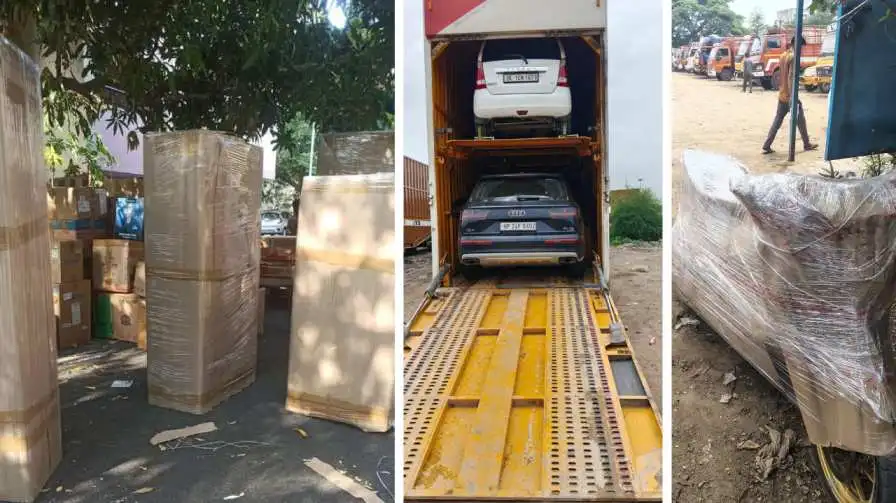
Car transport and bike transport from Pune to Varanasi
Cars and bikes usually travel on a carrier separate from the household truck. The budget figures below are planning guides for the Pune to Varanasi route.
| Vehicle | Planning budget guide |
|---|---|
| Bike, 100–150 cc | ₹6,000–₹8,500 |
| Bike, above 150 cc | ₹8,000–₹11,500 |
| Hatchback car | ₹16,000–₹22,000 |
| Sedan or SUV | ₹20,000–₹28,000 and above |
The exact make, model and condition are assessed for each vehicle, along with the carrier’s schedule. A hydraulic carrier, an enclosed carrier or crating is not added automatically. Where a particular vehicle needs one, that is confirmed in writing before the booking.
Special cases
Electric, modified and non-running vehicles need acceptance confirmed first and carrier preparation planned, because loading a non-running vehicle takes different equipment and handling. Share the model and the condition up front.
Preparation
Ask the operator what fuel level or battery state the carrier needs, rather than guessing. Draining engine oil is not part of preparing a vehicle for transport. Take out personal items and valuables unless the operator agrees in writing that something may stay inside. Photograph the vehicle on all sides at handover and keep registration papers and your identity documents ready, with the operator naming which copies are needed.
As a planning guide, a bike takes about 5 to 7 days and a car about 4 to 6 days, on a carrier schedule that is planned and confirmed separately from the household move. Compare the vehicle’s confirmed arrival window with your own travel date and plan local transport if they differ. Agree safe accepted handover points and record keys, accessories and the vehicle receiver.
Services and the process from enquiry to unloading
ALPM handles household moves, small moves with only a few items, office moves, and car and bike transport on the Pune to Varanasi route. The work covers packing, loading, transport and unloading, along with the technician work, dismantling and crating that your inventory calls for, each set out in the written scope.
Who the service suits
- Families moving a full home, from a 1 BHK to a larger household.
- Students and employees moving a few cartons, books and personal belongings, often as a part load.
- Office coordinators moving desks, files, computers and a small team’s equipment, where the receiving contact and building rules are fixed ahead.
- Owners who want a car or bike carried alongside the household move.
How the process runs
- You share the Pune address, the exact Varanasi or campus destination, the inventory and any vehicles.
- Access details are reviewed for both ends: floors, lifts, truck parking, gate rules and carry distance.
- A written scope is prepared with the work included, items named separately and the final total.
- Packing and loading take place in Pune against the agreed inventory and piece count.
- The goods travel on the planned route and schedule, with dispatch dates confirmed.
- Before unloading, the destination, receiver and access are reconfirmed.
- Goods are unloaded and placed as agreed, and the count and condition are checked with the receiver.
- Payments follow the milestones written into the quote.
Packing and loading come before departure. If goods are consolidated in a shared load, that adds time before the road days begin.
Agree room placement, item-level dismantling and reassembly, unpacking and packing-debris collection where requested. Choose protective materials for glass, screens and furniture, manageable cartons for books, and room labels for clothes and kitchen goods. The crew’s load plan should protect fragile packages and keep weight suitably distributed.
Why people ask ALPM for a written scope, and what to send when you enquire
ALPM, written in full as Agarwal Logistics Packers and Movers or Agarwal (ALPM) Packers and Movers, builds its Pune to Varanasi quotes from the inventory and access details you provide, and it puts the scope in writing. That means the destination is discussed before the price is final, items that cost extra are named once, and the account of what is included matches what the crew will actually do. The aim is a plan that fits your move, not an average one.
The Pune office is at Office No 18, Sector 24, Near Ramdev Dhaba, Transport Nagar, Nigdi, Pune 411044. The registered office is at Old Bowenpally, Secunderabad. The phone number is +91 9467186002. Several moving businesses use similar names, so check that the business name, phone number and address on any written quote match what you were told before you pay anything.
Details that make a quote accurate
- The pickup locality in Pune, the type of building, the floor and whether a lift is available.
- The exact Varanasi destination: a city flat or house, the BHU main campus, or Rajiv Gandhi South Campus.
- Whether the room, hostel or quarter has been allotted, and whether the institution has granted entry permission.
- The name, phone number and backup contact of the person who will receive the goods, and their available window.
- An inventory of rooms and large items, the number of cartons, and which are books or personal items and which belong to an institution.
- Any car or bike, with its make, model and running condition.
- Your preferred dispatch window and how flexible it is.
- Photos of the approach road, gate or lift at either end, if you can share them.
With these in hand, the budget guide narrows to a written figure and the calendar narrows to a dispatch plan you can rely on.
Payment, cancellation, date changes and transit cover
Money terms are easier to settle before booking than after the goods are packed. Ask for them in writing and read them alongside the scope.
Payment milestones
The written quote should say what is payable at booking, what is due before loading or dispatch, and what is due at delivery. If the schedule is not on paper, ask for it to be added before you pay the first amount.
Cancellation and date changes
Plans change, especially when a room allotment, a joining date or a lease handover shifts. The terms for cancelling, or for moving the pickup or delivery date, should be set out in writing and should say how charges apply at each stage, such as before a vehicle is assigned, after a crew has been scheduled, or after loading. Ask what happens if you change the date, and what happens if the destination is not ready on the agreed date. No free cancellation or free rescheduling should be assumed unless the written terms say so.
Documents
Documents that apply to your particular goods, whether household items, a vehicle or office equipment, are named by the operator in writing, along with the copies of your own identity papers that are needed. Keep originals with you.
Transit cover
Cover for goods in transit is optional and is provided on the terms of the insurance provider. Ask for the policy wording before you choose it, and look at the declared value, the exclusions, the way a claim is made and the documents a claim needs. A photographed and itemised inventory made before loading is useful if a claim is ever needed.
Read the quote once more, with the scope, the extras, the milestones and the cancellation terms side by side, before you confirm.
Keep the receipt and booking reference. At delivery, record visible condition or count differences on the paperwork, check contents while unpacking and notify the booking contact promptly with photos and the inventory reference under the agreed claim procedure and deadlines.