

Packers and Movers Pune to Bhubaneswar: Charges, Timing and Delivery
The road from Pune to Bhubaneswar is around 1,600 km as a road planning guide. For a 2 BHK, indicative charges are ₹19,500–25,000 on a shared truck and ₹28,000–34,500 on a dedicated one. Counted from actual dispatch, shared loads take about 7–10 days and dedicated trucks 4–5 days, with packing and any consolidation time counted before departure.
Pune to Bhubaneswar moving overview
| Route distance | Around 1,600 km road planning guide; actual truck route and addresses vary |
| 2 BHK guide | Shared ₹19,500–25,000 / dedicated ₹28,000–34,500; GST and optional cover separate |
| Transit after dispatch | Dedicated 4–5 days / shared 7–10 days; packing and consolidation can add time before departure |
| Bhubaneswar receiving | Confirm exact Unit/block, building gate, dry unloading path and receiving slot |
| Car and bike | Exact-model carrier assessment with its own collection and arrival calendar |
Get Free Quote
On this pageView sections
Pune to Bhubaneswar distance and how long the move takes
Plan on around 1,600 km of road between Pune and Bhubaneswar. Map checks show about 1,575 km on the main NH65 and NH16 option, with alternatives of roughly 1,604 km and 1,702 km, so 1,600 km is a sensible planning figure rather than an exact one. The route your truck actually takes depends on the dispatch date, the pickup and delivery addresses, and road conditions at the time.
One possible coastal corridor runs through Pune, Solapur, Hyderabad, Vijayawada, Visakhapatnam, Berhampur and then Bhubaneswar. That describes the general line of travel. These towns are not compulsory stops, and not every shortest route passes through all of them. Toll charges vary by vehicle and route. The written quote should show them within the transport charge or once as a separate line, so they are not charged twice.
Planning windows after dispatch
| Mode | Planning window | Counted separately |
|---|---|---|
| Dedicated truck | About 4 to 5 days | Packing and loading before dispatch |
| Shared load | About 7 to 10 days | Packing, plus any wait while the load is consolidated before the truck leaves |
The clock starts when the truck actually leaves Pune, not on the day you book or the day packing begins. A shared load may wait for other goods to be added before it departs, and that wait is on top of the 7 to 10 days. A passenger-car driving estimate does not include the full goods-movement schedule, driving breaks or receiving arrangements. Plan the goods for the specific gate, lift and room, rather than booking a lift from a car journey estimate.
Before dispatch, ask for a confirmed arrival window and tell the crew about any date that genuinely cannot move. Road, traffic and weather can shift a schedule, so ask for a fresh update once the truck is on the road.
Choosing dates: cyclone months and Puja weeks
Keep two calendar checks separate from the dry-unloading arrangements below:
- Cyclone-season planning. Cyclone activity in the Indian seas has pre-monsoon and post-monsoon peaks, notably around May–June and October–November. This is a reason to check the current IMD warning for the actual coastal corridor, not a prediction that your moving day will be disrupted. Leave some flexibility before a fixed joining or home-handover date. If a relevant warning changes dispatch or arrival, agree the revised slot and waiting or holding arrangements; a fixed one- or two-day delay cannot be assumed.
- Durga Puja dates. Before choosing a delivery day in Bhubaneswar during Puja, ask the receiver whether a nearby pandal, procession or local traffic arrangement affects the final approach. Confirm the society office, receiver, crew entry and lift slot for that date. Consider a daytime or alternative slot if the property confirms it is more workable; a festival does not make every locality inaccessible.
Shared load, dedicated truck or a few items: which mode fits
The right mode depends on how much you are moving, how fixed your dates are, and how many times you are comfortable with your goods being handled on the way.
| Mode | Usually suits | Timing after dispatch | How it is priced |
|---|---|---|---|
| Shared load | 1 BHK or 2 BHK homes, flexible dates, people who can accept a longer wait | About 7 to 10 days | A share of truck space based on your inventory |
| Dedicated truck | 3 BHK and larger homes, heavy furniture, a firm delivery date, or items you would rather not have transferred between vehicles | About 4 to 5 days | A vehicle for your goods alone |
| A few items | A bed, wardrobe, television, cartons and suitcases for one person or a couple | Usually a shared load, so the shared window | Quoted from your item list; no fixed band is given here because volume decides it |
| Car or bike | Vehicles moved separately from the household goods | Agreed in the written scope | See the vehicle section below |
| Office assets | Desks, cabinets, racks and workstations | Agreed for the project | Based on the asset register |
If you cannot decide, count your large pieces. A sofa, double bed, wardrobe and refrigerator already take real space, and a 2 BHK with a full set of furniture may sit near the top of the shared range or justify a dedicated quote. Ask for both options in writing and compare the arrival window as well as the price.
House shifting charges from Pune to Bhubaneswar
The figures below are indicative guides for a household move on this route. Your final amount depends on your inventory, access at both addresses and the date.
| Home size | Shared truck | Dedicated truck |
|---|---|---|
| 1 BHK | ₹15,000–₹19,500 | ₹22,000–₹27,000 |
| 2 BHK | ₹19,500–₹25,000 | ₹28,000–₹34,500 |
| 3 BHK | ₹26,000–₹33,000 | ₹36,000–₹44,000 |
| 4 BHK | ₹32,500–₹42,000 | ₹48,000–₹58,000+ |
Each range is meant to cover the agreed packing material, packing labour, loading, transport, unloading and furniture handling, as listed in your written scope. Check that every one of these is named in the quote, so you know exactly what the price includes.
Some items are shown separately at their actual amount: GST and any optional transit cover. Where they apply to your move, access difficulty (a long carry, no lift, stair turns), furniture work not already included in the agreed scope, technician work and goods holding are also written as their own lines with an explicit amount. Seeing them itemised once, before you agree, is the whole point.
What moves a quote up or down
- The number and size of large items, and how many cartons you have.
- Floors and lifts at both ends, and how far the crew must carry goods between the vehicle and the door.
- Fragile or high-value items that need extra packing.
- Furniture that has to be dismantled and refitted.
- Flexibility on dates, since a shared load is easier to match when your dates can move.
- Whether any goods need to be held before delivery.
If a quote is much lower, check whether unloading, furniture handling or access charges have been omitted. Compare quotes line by line, not just by the total.
Getting the Pune or PCMC pickup ready
Access can delay pickup even when packing is ready. Many societies in Pune and Pimpri-Chinchwad ask residents to book the lift, restrict moving hours, issue a gate pass or require a permission before a goods vehicle enters. Check these first, then pass them on with your inventory so the crew size, vehicle and timing fit the building.
- Where the truck can actually stop, and whether a larger vehicle can enter or goods must be carried to a vehicle waiting outside.
- Lift availability, cabin size and any booking slot, or the number of floors if there are only stairs.
- The permitted moving hours and who authorises the gate pass.
- Whether large furniture must be dismantled in the flat or can leave in one piece.
Packing day
Packing normally takes place before loading, and on a shared load it may happen a day or more before dispatch. Keep daily essentials, chargers and documents out of the cartons. Label cartons by room in plain words, such as Kitchen or Bedroom 2, and keep one list with a carton count for each room. The count taken at pickup is what the count at delivery is checked against.
Take clear photos of furniture, screens and appliances before they are wrapped. They show the condition at pickup and make any later question easier to settle.
Furniture and appliances: measure first, prepare properly
Large furniture is a common source of surprises on moving day, at either end. Before anything is loaded, check that each big piece can physically leave your flat and fit into the new one.
- Measure each large piece as packed, in width, height and depth, since wrapping and edge protection add to its size.
- Measure the usable door width at both homes (the clear opening once hinges and frames are accounted for), the usable lift doorway, cabin interior and load limit, and any turns on the staircase.
- Ask the crew to confirm before loading that every large piece can be taken out and placed at the other end, and whether dismantling is needed. Dismantling is assessed piece by piece and quoted when it applies.
Appliances
Keep the manual for each appliance where you can find it. If a washing machine’s manual calls for transit bolts, they are fitted for the journey and must be removed before the first use in the new home. Air conditioner gas work, electrical and plumbing connections and IT equipment should be disconnected, reinstalled and tested by a qualified technician, not the packing crew. Book that technician for the Bhubaneswar end ahead of the truck, so installation is not waiting on you. For a refrigerator, follow the manufacturer’s guidance on emptying it, securing it and how long to let it stand before switching it on.
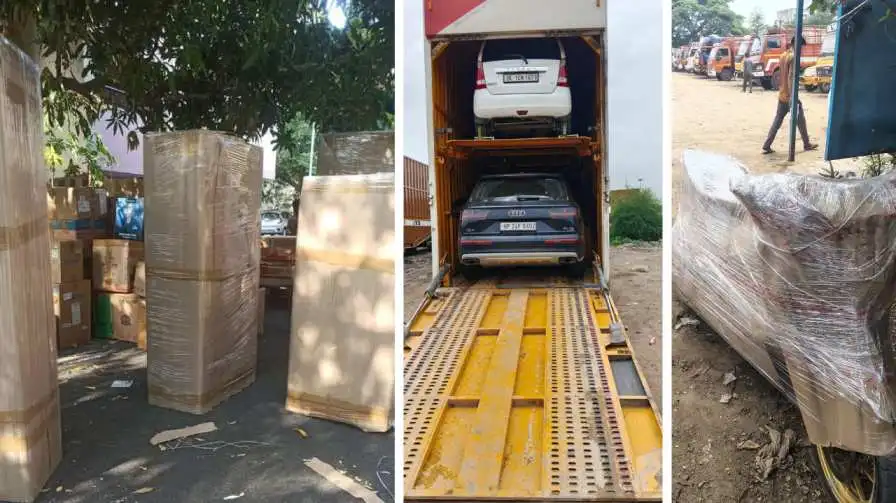
Writing your Bhubaneswar address so the crew can find the door
A locality name is not enough for a driver or a crew. Some Bhubaneswar areas cover many separate blocks, campuses and lanes, so give the address the way the person at the gate would need it.
| Area | What to write | What to confirm before dispatch |
|---|---|---|
| Unit areas (Unit 1 to Unit 9) | The actual unit number, the block or house number, and the lane or gate. Unit 1 to 9 is not one address. | Whether the vehicle can reach the gate and where the crew can stop. |
| Patia and Chandrasekharpur | The campus, society or apartment name, tower or block, flat number and the service gate, not just the main entrance. | Who authorises entry (the society office or receiving authority), delivery hours and how the lift is booked. |
| Old Town | The actual lane and door number, with a phone number for someone who will meet the crew. A temple or market landmark alone is not enough. | Where a vehicle can halt and how far goods must be carried from there. |
| Pokhariput, Tamando and Pahala | The actual building name, the gate and a map pin for that gate. Treat these as three separate localities. | Whether the vehicle can reach the gate. Do not assume these areas are closed to trucks or that every road is narrow; check the actual approach. |
Share a map pin for the gate or building entrance, along with the phone number of the person receiving the goods. If the main truck cannot reach the gate, first assess whether a safe, permitted small-vehicle transfer is feasible. Agree its location, crew, operator, package IDs and physical count, condition records and added handling price before booking. A long hand-carry and a second vehicle are different services.
A dry unloading plan, from the parked truck to the flat
Bhubaneswar can see heavy rain, and weather can change within a day. Good packing protects goods inside the truck, but it is not a promise that cartons stay dry while being carried across a wet yard. What keeps things dry at delivery is a plan for that short stretch from the parked truck to the room, agreed before the truck leaves Pune.
Check the weather at three points
Look at current forecasts and official weather warnings when you book, again before dispatch, and again as the truck gets close. This is information for decisions, not a guarantee in either direction. A clear forecast at dispatch can change by arrival, and a poor one may pass.
What the receiver confirms before dispatch
| Check | What to agree | Why it matters |
|---|---|---|
| Truck stopping point | Where the vehicle will stand, and whether a covered loading bay is available | Goods should not wait in an open yard |
| Walking path | A usable route from the vehicle to the lift or door that is dry and safe to carry along | Wet steps and ramps put both people and goods at risk |
| Dry indoor staging | An authorised dry indoor space, with a clean raised base where needed, that does not block a walkway or emergency exit | Gives goods somewhere to go straight away |
| Crew route | The safe route and any area the crew should avoid | Reduces slips and damage |
| Lift and placement slot | Lift booking, cabin size, load limit and a time slot long enough to place all goods, not only the first loads | A half-finished unloading is when goods are most exposed |
| Receiving authority | The name and phone number of the person who approves entry and signs for the goods | Stops the truck waiting at a gate |
If the path is unsafe or a relevant warning affects unloading
Do not unload into rain, and do not block a road or gate to try. If the path is wet or unsafe, or a relevant warning makes unloading unsafe, the crew can pause. Decide together on one of two outcomes, and agree a contingency before dispatch. Reconfirm the actual conditions and feasible arrangement if a delay occurs.
- A safe alternate slot that is workable for the truck, the crew, the society and you, such as later the same day or the next morning, with any waiting charge stated.
- Confirmed holding, with the location, the operator, who has custody of the goods, package IDs, physical counts and condition, how long it will last, the rate and how the goods will be redelivered.
Neither outcome is automatic. A sheltered place is not guaranteed unless it is confirmed in your written scope, so do not assume one.
Record condition and place before you unbox
Photograph cartons and large pieces before they are sealed, note the carton or seal ID numbers on your list, and check the counts and visible condition as each package comes off. Send electronics and other sensitive cartons to the driest space first. Finish unloading and placing everything before you start unboxing, and leave power testing of appliances until after that, following the manuals or a qualified technician.
A worked example: a 20-package flat in Patia
This illustrative plan shows how to prepare the receiving end. Imagine a flat in a gated society in Patia that receives 20 packages, two of which hold electronics.
| Stage | What happens | What is recorded |
|---|---|---|
| Before dispatch | The receiver confirms the service gate, who authorises entry, the lift slot and a dry indoor zone, such as the flat’s living room with the floor covered. They also decide in advance what will happen if weather delays arrival. | The zone, gate, lift slot and the weather-delay choice, written into the scope or the message thread |
| At packing in Pune | E01 and E02 identify the two electronics cartons, while G01–G18 identify the other 18 packages: 20 physical packages in total. Any separately packed furniture panels also need their own counted IDs. | Photos of each pack, its seal or ID number, and the total count of 20 |
| At delivery | The truck stops at the agreed point and goods move along the dry route. The receiver uses the agreed dry indoor spaces: one for the 18 general packages and one for E01 and E02, away from any open window. | The count against the list, plus visible condition and seal numbers as each pack comes off |
| If the weather turns | Unloading pauses. The agreed alternate slot or holding arrangement is used. | The new time, or the holding terms |
| After placement | Unboxing starts once every package is in place. Appliances wait for their manuals or a qualified technician. | Any wet packaging, marks, damage or missing package noted on delivery paperwork with photos and reported promptly |
The same checks scale up or down. A 3 BHK follows the same plan with more packages and probably a longer placement slot.
Car and bike shifting from Pune to Bhubaneswar
Vehicle charges below are indicative and depend on the exact model and its condition. The type of carrier, any cover and the inclusions are agreed in the written scope, not assumed from this table.
| Vehicle | Indicative charge | Note |
|---|---|---|
| Scooter or 100–150cc bike | ₹4,000–₹6,000 | Confirm the model and whether it runs |
| 350cc and above cruiser | ₹6,500–₹9,000 | Heavier machines need suitable handling, so share the exact model |
| Hatchback | ₹11,000–₹15,500 | Share the make, model and running condition |
| Sedan or SUV | ₹15,000–₹21,500 | Size and ground clearance affect carrier arrangements |
Bikes above 150cc and below 350cc, electric vehicles and any model not listed are assessed individually, and no price band is given for them here. Tell ALPM the exact model and variant, whether the vehicle runs, any existing damage and any modifications. EV handling, battery preparation and acceptance must follow the manufacturer and carrier instructions. Non-running vehicles need different handling, so say so at the start.
Before the carrier arrives
- Remove personal belongings from the vehicle.
- Photograph every side, the interior and the odometer, and note existing marks.
- Keep the registration and insurance papers with you, and record supplied keys and accessories at handover.
- Follow preparation steps agreed with the carrier and consistent with the manufacturer’s instructions, and agree who will inspect the vehicle on arrival in Bhubaneswar.
Vehicles can travel on their own schedule, which may differ from the household truck. Ask for the vehicle’s separate dispatch and arrival window.
Office relocation to Bhubaneswar
ALPM moves the physical assets of an office: desks, chairs, cabinets, racks, workstations, printers and boxed files. Data, networks and configuration stay with your own IT team or a qualified IT contractor.
- Give every asset a physical ID tag and keep a register with the tag number, description, physical package and accessory counts (cables, adapters, keyboards, mounts), condition and the person releasing it.
- Name a person in Pune who releases the assets and a receiver and backup in Bhubaneswar, and have both sign the register so each handover is documented.
- Pack accessories with their device and label them against the asset tag.
- Check building rules at both ends, such as lift booking, loading hours and security permissions, because office buildings are often stricter than residential ones.
Have a qualified IT person power down, disconnect, reconnect and test the equipment, and take your own backups before anything is moved. Plan the arrival so work can restart in stages. Allow downtime and schedule setup against the agreed delivery window. A weekend dispatch does not ensure a weekend delivery. The dry unloading plan above applies to office electronics too.
Holding goods when the new place is not ready
Goods sometimes need to wait: a flat is still being finished, a society has not given permission, or the weather stops safe unloading. Holding is available when assessed and agreed, but it is not an automatic add-on, and no free period is assumed here.
Before any holding starts, get these terms in writing:
- The location where the goods will be held.
- The operator who runs that place.
- Who has custody of the goods and what that covers.
- Package IDs, physical counts and condition at handover.
- How long the holding will last.
- The rate and how it is charged.
- Whether you can visit or retrieve items during the holding period.
- How and when the goods will be redelivered, and at what cost.
Also ask whether the goods stay on the truck or are unloaded into a premises, because these are different arrangements. If holding is decided after dispatch because of weather or delay, ask for the same details before you agree, even if only by message. Put a date on a review so goods do not sit longer than needed.
What stays with you, what is not carried, and paperwork
Keep with you
Carry valuables, jewellery, cash, medicines, identity and property documents and your laptop yourself instead of loading them onto the truck.
Not carried
Fuel, LPG cylinders and fireworks are excluded, along with similar hazardous items. If you have plants, declare them in advance. A long journey can be hard on plants, so acceptance is decided case by case before booking.
Paperwork
You will usually need an itemised inventory, a copy of your identity proof and details of both addresses. For a vehicle, bring its registration and insurance papers. Which transport and billing documents apply depends on your goods, the scope and your own situation, so ask ALPM to list what it will issue, and tell it early if your employer needs a particular bill format for reimbursement. Confirm the documents needed for your particular consignment before loading.
Optional cover
Transit cover, where taken, is optional and sits under the provider’s written terms. It is shown as a separate line at the actual amount, and it is not assumed to be part of the price. Before you decide, ask for the policy wording, how the declared value is set, what is excluded and the steps to make a claim.
How to compare movers, and what ALPM offers
Whichever company you choose, compare quotes on the same inventory and the same access details. These questions are worth putting to every mover:
- Is the quote based on your actual list, with both addresses, floors and lift details?
- Does it name what is included: packing material, labour, loading, transport, unloading and furniture handling?
- Are GST, cover, access, holding and technician charges shown as separate lines?
- Does it give an arrival window counted from actual dispatch, and say what happens if a delivery slot fails?
- Who will physically handle the goods at each end, and how can you reach them?
- What are the terms for holding and for raising a damage query?
ALPM trades as Agarwal Logistics Packers and Movers and is also written as Agarwal (ALPM) Packers and Movers. It works from a direct enquiry that starts with your inventory and the access at both ends, and it gives you a written scope. Its services cover household moves, few-item moves, office physical assets, car and bike moves, packing, furniture dismantling after assessment and goods holding. Ask for any registration or reference details you wish to confirm, and weigh the answers alongside other quotes so you choose on substance and not on the lowest number alone.
Booking, changes and support
- Send your inventory (a room-by-room list is fine), both full addresses with floor and lift details, and your preferred dates. Photos or a short video of bulky items help.
- ALPM reviews the inventory and the access, and may ask about door widths, parking or the lift.
- You receive a written scope and price that names what is included and lists the separate items.
- You agree the packing date, expected dispatch and arrival window, and the receiving plan for Bhubaneswar. Read the advance, cancellation and rescheduling terms before paying.
- Packing and loading take place, counts and photos are recorded, and the truck is dispatched.
- Before arrival, check the forecast again and confirm the receiver, the placement slot and the staging space with the crew.
If something changes
Tell ALPM as soon as you know about a new date, extra items or a change in access, such as a lift out of service or a flat that is not ready. Changes can alter the vehicle, the crew or the price, so ask for the updated scope in writing. Changes after dispatch are harder to accommodate, so the earlier you say, the better.
Support
You can reach ALPM on +91 9467186002. The Pune office listed for the business is Office No. 18, Sector 24, Near Ramdev Dhaba, Transport Nagar, Nigdi, Pune 411044, and the registered business location is Old Bowenpally, Secunderabad. Before the move, agree how you will get updates in transit and whom you should call on the day of delivery in Bhubaneswar.