

Packers and Movers Goa to Bhubaneswar: Charges and Delivery
For a Goa to Bhubaneswar move, a 2 BHK planning guide is Rs 22,000–28,000 on a shared load or Rs 29,000–36,000 with a dedicated truck. The current city-level road reference is about 1,660 km, with roughly 4–6 days allowed for the road leg after actual dispatch. Packing, shared-load consolidation and destination handover need their own time. Use the charges, service details and Bhubaneswar receiving plan below to arrange the whole move.
Goa to Bhubaneswar moving overview
| Road reference | About 1,660 km; actual pickup, delivery gate and loaded route vary |
| 2 BHK guide | Shared ₹22,000–28,000 / dedicated ₹29,000–36,000 |
| Road transit guide | Roughly 4–6 days after actual dispatch; packing and consolidation precede this |
| Bhubaneswar address | Confirm phase/sector, building, gate and floor |
| Arrival preparation | Permitted covered staging, package count and condition check |
Get Free Quote
On this pageView sections
How far is Goa from Bhubaneswar by road?
Google Maps shows about 1,663 km for a passenger car between the two cities via NH16, with roughly 30 hours of driving time. The Maps check on 17 October 2026 supports a rounded city-level reference of about 1,660 km. Allow for different pickup points, delivery gates and a suitable loaded-vehicle route rather than treating this as a measured truck trip.
Why your own distance may differ
- Your pickup may be in Panaji, Margao, Mapusa, Vasco or another part of Goa, and each starts the journey from a different point.
- Your delivery may be in Patia, Old Town, Khandagiri or elsewhere in Bhubaneswar, and the last stretch changes with the gate and the lanes leading to it.
- A loaded goods vehicle is not guaranteed to follow a car’s route, so the actual route is settled at dispatch.
Distance is useful for checking that a quote is in a sensible range. On this route, though, the amount you pay is shaped much more by inventory, the vehicle arrangement and access at both ends than by a few kilometres either way.
Delivery time: what the 4-6 day road leg covers
For Goa to Bhubaneswar, allow roughly 4–6 days for the road leg once the vehicle has actually left. Traffic, weather, rest stops and the receiving window can change this guide. Packing, loading, any shared consolidation and final unloading sit outside that road-transit count.
| Stage | What happens | What to confirm |
|---|---|---|
| Booking and survey | Inventory, photos or a video walk-through, and address and access details are reviewed | That the written quote lists your item groups and the access at both ends |
| Packing and loading | Items are packed to the agreed standard and loaded at the Goa address | The loading date and the likely finishing time |
| Shared consolidation | In a shared load, goods may wait while the vehicle is filled or other pickups are completed | The latest dispatch date you can accept, in writing |
| Road leg | The vehicle travels toward Bhubaneswar; 4-6 days is the planning reference counted from actual dispatch | How you will be told about dispatch and about the expected arrival |
| Arrival and unloading | Entry, staging, unloading and handover at the confirmed gate | The arrival window, who will receive, and the plan if rain or access delays it |
The 30 hours Maps shows for a passenger car is a driving figure, not a delivery promise. A loaded goods vehicle does not travel the same hours, and packing, consolidation and unloading all sit outside it.
Ask for the whole window
- Ask for the expected period from your first pickup day to the final delivery day, not just the road leg.
- If you are on a shared load, ask what happens if the load fills later than planned.
- If you have a fixed move-in date, say so at the start, because it affects whether a shared or dedicated arrangement fits.
If an Odisha warning changes dispatch or the journey
A cyclone or severe-weather warning affecting Odisha or a stretch of the operator’s selected corridor needs a dispatch decision as well as the rain-day arrival checks below. Check current IMD and local directions with the operator for the actual dates and route. If the warning applies before loading, compare a revised pickup or dispatch appointment before committing goods to the journey. If goods are already travelling, ask the named update contact for the revised progress and receiving window; do not ask the driver to press on to preserve an old ETA.
Clarify what a pause means for your consignment. Remaining secured on an accepted vehicle and being unloaded into a separately accepted holding location are different arrangements. Obtain the responsible custodian, package and condition record if goods are transferred, handling involved, any charge requiring approval and the revised release and delivery plan. A delayed ETA does not itself establish a warehouse charge. Once movement can resume, reconfirm the Kanan Vihar phase or other actual address, permitted covered staging and receiver before arrival. Do not replace this check with an automatic one- or two-day buffer.
Household shifting charges and how to read them
The guide below covers household moves from Goa to Bhubaneswar. Each figure includes agreed standard packing, loading, transport, unloading, fuel and tolls. These are indicative ranges for an assessed inventory, and your written quote is what finally counts.
| Home size | Shared load | Dedicated truck |
|---|---|---|
| 1BHK | Rs 16,000-21,000 | Rs 22,000-27,000 |
| 2BHK | Rs 22,000-28,000 | Rs 29,000-36,000 |
| 3BHK | Rs 28,000-36,000 | Rs 37,500-46,000 |
| 4BHK | Rs 36,000-46,000 | Rs 47,000-58,000 |
Comparing these totals with other figures
Quotes and directory numbers for this route are often not like for like, so check what each one is measuring before comparing.
- A freight-only figure covers the transport but may leave out packing, loading and unloading. Our guide includes those, so do not add them again.
- A within-Goa calculator, such as a 2BHK local move figure, is for a local move. It says nothing about a 1,660 km intercity journey.
- A per-session or per-visit listing amount is not evidence of the price of a whole intercity move. Ask which work and distance it covers.
- If a quote already includes fuel and tolls, they should not appear again as separate lines.
What can add to the total
GST, optional cover, difficult access, a technician for fitted items and optional holding can add to the total. Each is counted once, and only if it is not already part of the agreed scope. Ask the quote to show which of these are included, which are extra and what each costs, so nothing appears for the first time on delivery day.
Household Packing, Furniture and Loading
Packing for this Goa–Odisha journey starts with the goods themselves: carton strength for books and kitchenware, surface and corner protection for furniture, and suitable cushioning for fragile pieces. Keep items and cartons dry before sealing, and agree protection for any exposed carry between the home and vehicle.
What the standard packing covers
Standard packing is agreed after the inventory is reviewed. It normally covers cartons or wrapping for everyday household goods, protection for furniture surfaces and corners, and labelling by room. Ask the quote to list what is packed and what you are expected to pack yourself.
Items that need a decision before pickup
- Televisions and screens: ask how they will be boxed and whether the original carton is available.
- Fridges, washing machines and other appliances: ask what preparation is expected from you, such as emptying and drying an appliance or fitting manufacturer-specified transit restraints. Follow the appliance instructions; do not improvise washing-machine restraints.
- Mattresses and upholstery: ask whether plastic wrapping is part of the scope, since these soak up moisture easily.
- Glass, mirrors and framed items: ask how they are protected and whether they travel upright.
- Specialist crating or holding: these are done only when the item is assessed and agreed, not added automatically.
Label each physical package with an inventory ID and destination room. Bag furniture fasteners, identify the matching piece and record who keeps the fittings. Confirm dismantling and reassembly separately from electrical or plumbing reconnection.
Keep with you
Carry documents, jewellery, medicines, chargers, laptops and a first-night bag yourself. They are easier to find on arrival, and they remain with you if the vehicle’s arrival date shifts.
Moisture on this route
Ask what is used for moisture-sensitive items rather than assuming it. Cartons should not sit on wet floors at pickup. Wrapping reduces exposure but does not make goods waterproof, which is why the arrival checks later on this page matter.
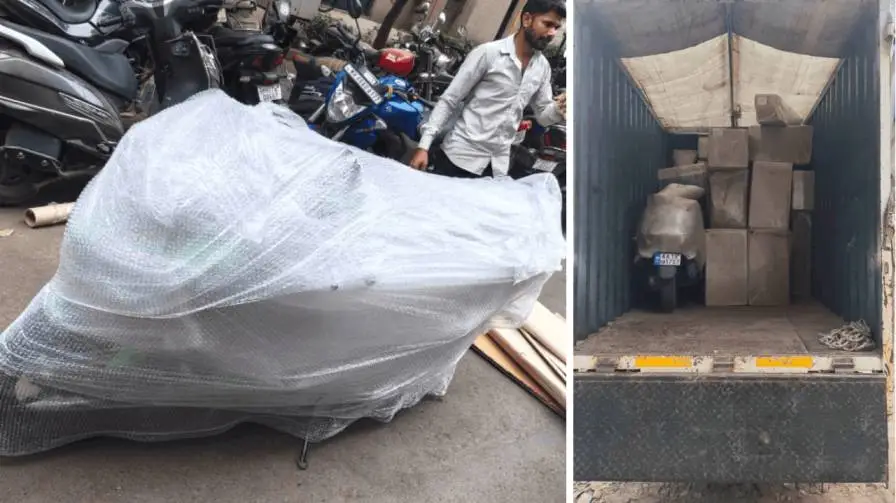
Car and bike shifting from Goa to Bhubaneswar
The vehicle guide below gives a starting range. The model, its condition, the carrying mode and the preparation needed are confirmed before booking, and no particular crate, enclosed carrier or cover is added automatically.
| Vehicle | Guide | Confirm before booking |
|---|---|---|
| Bike up to 150cc | Rs 5,500-7,000 | Model, condition, carrying mode and preparation |
| Bike above 150cc | Rs 8,000-11,000 | Weight, condition, whether crating is assessed and agreed |
| Hatchback | Rs 11,000-14,500 | Model, condition and the arrangement used to carry it |
| Sedan | Rs 13,500-17,000 | Model, condition and the arrangement used to carry it |
| SUV | Rs 16,500-22,000 | Size, ground clearance, modifications and the carrying arrangement |
Prepare the vehicle
- Agree fuel or battery preparation with the carrier for the exact model, following the manufacturer’s guidance. Flag electric, modified or non-running vehicles for assessment.
- Remove personal items, loose accessories and anything valuable from inside the vehicle.
- Photograph every side, the roof and the dashboard with the date visible, and note existing marks.
- Keep the requested registration, insurance and owner documents ready. Record any key handed to the carrier; keep a spare separately.
- Mention any modification, such as a low body or an aftermarket fitting, which can change how it is carried.
Confirm vehicle collection and handover points and dates separately from household delivery; a car carrier need not arrive with the furniture truck.
At delivery, check the vehicle against your pickup photos before signing, and note any difference on the handover paper.
Office relocation and small loads
Office moves and small household loads do not fit a fixed rate card, so they are priced on the actual inventory. Send the item list and both addresses so packing, vehicle space and handling can be assessed together.
For an office move
- A list of workstations, desks, storage units, servers and network equipment, with a note on which items are fragile.
- Files and records, and how they are to be labelled or sequenced for unpacking.
- The working window available at the Goa end and at the Bhubaneswar end, including any building rules on lift use or weekend access.
- Who will receive the goods, and whether IT staff will be present to reconnect equipment.
Arrange data backups, approved device release and reconnection with your own IT staff. Heavy machinery, chemicals and unusual commercial loads require separate assessment and written acceptance; an office enquiry does not include them automatically.
For a few items
If you are moving a bed, a wardrobe, a few cartons or similar items, send photos and approximate sizes. A shared load is usually the sensible comparison, and the written quote should say how the items will be protected and what happens if the vehicle fills later than planned.
Extras, holding and cover
Extras are where quotes tend to drift apart, so ask for each to be written as in or out of the agreed scope.
- Technician work: fitted items such as split air conditioners and modular furniture may need a technician or dismantling. It is assessed from your inventory and counted once, if it is not already in the quote.
- Optional holding: if your goods need to wait before delivery, holding is assessed for availability and conditions. It is not an automatic warehouse stop. Ask for the location, start and end dates, access arrangements and a record of the goods’ condition when they go in.
- Optional cover: cover is a choice, not a default. If you want it, ask for the written terms covering what is declared, what is covered, what is excluded and how a claim is made. Do not assume any standard percentage.
- Specialist crating: this is done only for items that are assessed and agreed.
Never put visibly wet cartons into sealed holding. Damp goods held in closed packaging can deteriorate, so record the condition and arrange safe inspection or repacking first.
Pin down the Bhubaneswar address and access
The highway journey ends with a specific unloading point, not just the city name. Patia, Chandrasekharpur, Nayapalli, Khandagiri, Old Town and Samantarapur each include many different buildings, gates and approaches, so a locality name alone says little about whether a vehicle can reach the door.
Bhubaneswar’s municipal zone and ward listing names both phases of Kanan Vihar and the sectors of Niladri Vihar. For a mover, that is a prompt to give area, phase or sector, building and gate, not just a neighbourhood name.
What to share before dispatch
- The full address with area, phase or sector, building or tower and flat number, plus a map pin if you have one.
- The gate to use, and whether it is open to goods vehicles.
- Floor, whether there is a lift, and how large it is.
- Where a vehicle can stop, how wide the approach is and whether the last stretch is a lane.
- Any society rules on timings, deposits, permissions or security entry.
- A contact on site who can speak to the crew on arrival.
Assessment by address, not by area
We do not apply a blanket rule to a neighbourhood. Older lanes in Old Town or Samantarapur may need a closer look, but a flat in Patia or Nayapalli can have its own gate and lift limits too. If a larger vehicle cannot stop near the entrance, the options may include an agreed carry from a suitable standing point or a smaller vehicle for the final stretch. These are decided in advance and written into the quote with their cost, not assumed.
The figures on this page are for Bhubaneswar. Related destinations such as Cuttack or Jatni are not covered silently, and are quoted only when separately agreed.
Arrival decision matrix for Bhubaneswar
This matrix turns the arrival into a sequence of checks. Each row says what to do when things are clear, what to do when they are not, and what to write down. A safe unloading path matters more than keeping to the clock.
| Check | If it is clear | If it is not clear or not safe | Record before signing |
|---|---|---|---|
| Exact gate and approach | The vehicle goes to the confirmed phase or sector, building and gate | Pause. Call the receiver, confirm with a map pin or society security, and revise the plan before moving on | The gate used and the arrival time |
| Covered staging | Cartons are taken straight to a dry, covered spot such as a porch, lobby or room | If there is no covered path, wait for cover or shorten the route. Do not stage cartons on open or wet ground | Where goods were placed first |
| Package condition | Outer cartons are dry and intact | Set damp, crushed or torn packages aside and photograph them before they are moved further | Photos of the outer condition |
| Count | The count matches the loading list | Note any difference before the vehicle leaves the site | The count and any shortfall |
| Opening priorities | Open agreed essentials and inspect fragile or moisture-sensitive packages first | Arrange prompt, safe inspection of damp or suspect cartons with the crew present. Leave suspected wet electronics switched off | What was opened and what was found |
| Receiver sign-off | Sign after the count and a visible condition check | Write exceptions on the handover paper rather than signing a blank or clean form | A signed note listing any exceptions |
If conditions are unsafe, such as a slippery approach, standing water at the entrance or no covered route, the crew pauses and the plan is revised. Continuing regardless is not a time saving if goods get wet.
Illustration: Kanan Vihar phase I or II, with rain at delivery
Illustrative planning example: the sequence below shows decisions to agree before and during unloading.
A family is moving a 2BHK from Margao to a flat that the booking form lists as Kanan Vihar, Patia. When the address is checked a few days before dispatch, the building turns out to be in phase II, while the earlier note assumed phase I. The receiver confirms the correct phase and the building’s actual approach and gate. The address is corrected in writing, a map pin is sent to the driver, and the receiver’s phone number is added.
On delivery day it rains. The vehicle arrives at the corrected gate. The crew asks the receiver and security for a covered place to stop and a dry route to the entrance, and stages the cartons in the building’s covered entrance area, not on the open approach. Two cartons holding bedding are damp on the outside, so they are set aside, photographed and opened promptly. A television carton shows moisture at one corner. The television remains off and unplugged pending an inspection by a qualified technician or follows the manufacturer’s advice. Nobody tries to dry it or repair it themselves.
The family counts the cartons, notes the damp ones as exceptions on the handover paper, and signs only after that. Correcting the address before dispatch avoids sending the vehicle to an assumed gate; the condition record keeps any damp-package issue visible at handover.
Rain, damp cartons and electronics at delivery
If rain makes the approach slippery, flooded or exposed, pause and agree a safe covered unloading path before taking goods off the vehicle. A dry lobby is useful only when building staff permit staging there and it does not obstruct other residents.
Photograph damp, crushed or torn packages and record their inventory IDs. Arrange prompt, safe inspection and appropriate drying or repacking; do not leave visibly wet contents sealed for holding. Suspected wet electrical equipment should remain off and unplugged pending qualified inspection or manufacturer advice. A damp outer carton alone does not establish internal damage, so record what is actually found.
Before signing, compare the physical count and condition with the loading list, record exceptions and keep a copy. If optional cover applies, follow its reporting and evidence requirements promptly.
Documents, payment and cancellation
Ask for these in writing before you confirm the booking, so the move is not decided over the phone.
Documents
- A written quote listing your inventory groups, the vehicle arrangement, the packing scope and which extras are in or out.
- ID and address proof, if the mover asks for them.
- For a car or bike, the registration certificate, insurance copy and owner ID.
- Ask which transport paperwork applies to your consignment. The requirements for used household goods can differ from those for commercial goods, so confirm rather than assume.
- If your employer reimburses relocation costs, ask them what papers they need first, and ask us whether we can provide them. Do not assume a document will be accepted.
Payment
Ask the quote to state the payment stages and mode: what is due at booking, what is due at loading or delivery, and what is due only if an extra is added. Keep receipts for every payment.
Cancellation and rescheduling
Ask what happens if you reschedule or cancel at three points: before loading is arranged, after the vehicle is assigned, and after packing has started. A clear answer in writing is more useful than a general assurance.
Why Consider ALPM and How to Compare Movers
Compare quotes against the same inventory and Bhubaneswar receiving details. A cheaper headline is useful only when you know the packing, transport mode, handling and final payable scope behind it.
- A registered business identity you can check, such as a GST number, and a contact you can reach directly.
- A quote based on your inventory and access details, not just a distance.
- A clear split between what is included, what is extra and what is optional.
- A stated way of recording the condition of goods at loading and at delivery.
- Straight answers about timing, covering the whole period from pickup to delivery.
What to expect from ALPM
Agarwal Logistics Packers and Movers, also known as Agarwal (ALPM) Packers and Movers, is registered at Old Bowenpally, Secunderabad. Our GST number is 36FDRPM0957B1ZC and our trademark number is 7901417. We handle household moves, small loads, office relocation and car or bike shifting, and we take on specialist crating or holding only when the items have been assessed and the arrangement has been agreed.
Three mistakes to avoid before booking
- Giving only Patia or Khandagiri as the destination, without the building, gate and receiver.
- Comparing a transport-only amount with a full packing-and-handling total, or adding included fuel and tolls twice.
- Assuming the furniture truck, vehicle carrier and key handover all share one arrival time.