

Packers and Movers from Noida to Kochi: Plan the Cost, Timing and Delivery Door
A Noida to Kochi move covers roughly 2,660–2,780 km. A 2 BHK planning guide is ₹30,500–₹39,500, with provisional windows of 5–7 days for a dedicated household move and 7–10 days for a shared load. Confirm your inventory, exact Kochi door and unloading arrangements before booking.
Noida to Kochi moving overview
| City road guide | About 2,660–2,780 km; exact doors assessed |
| 2 BHK planning guide | ₹30,500–₹39,500; mode and scope assessed |
| Dedicated move plan | Provisional 5–7 days, packing to unloading |
| Shared load plan | Provisional 7–10 days from pickup, including consolidation |
| Kochi receiving | Exact door, unloading work order and dry staging ready |
Get Free Quote
On this pageView sections
Noida to Kochi road distance and route planning
By road, Kochi is roughly 2,660 to 2,780 km from Noida. The exact figure depends on which corridor a route planner suggests and which points in each city it measures from. Your door-to-door distance can fall outside that range. A tower in Greater Noida West and a house near Fort Kochi are not the reference points a map uses for the two cities.
Corridor names are labels, not the whole road
Map services describe the long-haul options with labels such as an NH44 corridor, an NH52 corridor, or NH52 combined with NH66. A label tells you the main highway on a suggested route. It does not mean a goods vehicle stays on one national highway from door to door, and it does not commit the truck to any particular list of towns or states. The operator decides the practical road for a loaded vehicle based on the vehicle type, permitted timings and conditions on the day. That road need not follow any single labelled corridor end to end.
Why 46 to 58 hours of driving is not your delivery time
Route planners show something like 46 to 58 hours for a private car on these corridors. Those private-car estimates do not include a household move’s packing, loading and rest arrangements. For a loaded goods vehicle, the driver needs proper rest, and a household move adds packing, loading, any consolidation, and unloading at the far end. Treat the map figure as a private-car travel reference, not a delivery promise and not a safe pace for a goods vehicle.
What the distance means for your plan
- Budget for a genuine long-haul job. Price grids built for regional moves do not stretch to this route on their own.
- Pack for several days of road vibration, heat, humidity and repeated handling, not a same-day drop.
- Settle the exact Kochi receiving address early. The last few kilometres inside the city can affect the day as much as the highway does.
- Keep a margin in your own calendar for work, school or lease dates, rather than planning around the earliest possible arrival.
Full truck or shared load: choosing the mode and reading its clock
For a Noida to Kochi household move, compare two transport arrangements. Your goods either travel in a vehicle arranged for your consignment alone, or they share space with other consignments going the same way. The choice affects cost, flexibility and how long you wait. Each mode also measures time differently, so it helps to know what a quoted window actually covers.
| Mode | Usually suits | What the clock covers | Provisional window |
|---|---|---|---|
| Dedicated vehicle (full truck) | Full homes, tight dates, goods that should not be handled at an extra stage | From the start of packing in Noida to the end of unloading in Kochi | About 5 to 7 days |
| Shared load (part load) | Smaller homes, students, partial inventories, flexible dates | From pickup in Noida, including consolidation and handling, to delivery | About 7 to 10 days, and it can run longer |
| Car or bike | Vehicles moving with or separately from household goods | Its own pickup and handover calendar, set after assessment | Agreed per vehicle; not assumed to match the household goods |
A dedicated vehicle
A dedicated booking reserves the vehicle for your consignment rather than waiting for a shared load to be assembled. Confirm whether the proposed plan involves any transfer, and who has custody at each stage. It usually costs more than sharing, and it is the better fit when you have a full home, a fixed joining date, or many fragile pieces you would rather not see moved more than necessary.
A shared load
A shared load can bring the cost down for smaller inventories, because you pay for the space your goods use rather than a whole vehicle. The trade-off is time and control. Goods may be consolidated with other consignments before the long run, and the delivery date depends on how the shared trip comes together. Do not book a shared load if you must have everything in Kochi on a specific day.
Vehicles keep their own calendar
A car or bike is assessed and scheduled separately. It may be picked up on a different day from the household goods and handed over on a different day in Kochi. Do not assume the car will arrive in the same truck or at the same time as your furniture unless that has been specifically agreed in writing.
Ask for the window in writing
The windows in this guide are planning estimates for a long road move. Confirm them for your booking rather than treating them as a fixed arrival date. Before booking, ask for the actual window for your mode, your dates and your address. Make sure it states when the clock starts: at packing, or at pickup.
Noida to Kochi shifting charges: a planning guide
The figures below are planning ranges to help you budget. They come from market price guidance for long-distance moves on this kind of route. Confirm the payable amount through a quote built from your inventory. Your actual price depends on what you are moving, how it is packed, the access at both ends, the mode and the date.
| Home size | Planning range | Notes |
|---|---|---|
| 1 BHK | About ₹20,500 to ₹27,500 | Varies with inventory, packing and access |
| 2 BHK | About ₹30,500 to ₹39,500 | Varies with inventory, packing and access |
| 3 BHK | About ₹44,500 to ₹51,500 | Varies with inventory, packing and access |
| 4 BHK and larger | Quoted after an inventory assessment | No standard range is given; volumes vary too widely |
| Vehicle | Planning range | Notes |
|---|---|---|
| Standard running car | About ₹11,000 to ₹21,000 | Depends on model, mode, pickup and handover points; confirmed after assessment |
| Standard bike | About ₹6,000 to ₹15,500 | Depends on model, packing and endpoints; confirmed after assessment |
How to read these ranges
The low end of a band is not the shared-load price, and the high end is not the dedicated-truck price. Light furniture and usable lifts reduce the handling work; heavy wardrobes, many fragile pieces and a long carry can increase it. A dedicated vehicle, unusual inventory or different endpoint can require a quote outside the guide. Because the longer corridor can exceed some generic distance grids, vehicle moves in particular need an assessment rather than an assumption.
What the core quote should cover
- Packing of the agreed inventory, with materials suited to each item
- Labour for packing and loading in Noida
- Road transport to Kochi in the agreed mode
- Unloading at the agreed Kochi address with normal access
- Any dismantling, reassembly or unpacking that you have specifically agreed
What is usually priced separately or must be written into the quote
- Applicable GST, shown on the quote
- Optional transit cover, if you select it
- Storage or holding, if your Kochi door is not ready
- Special crates for particular items
- Waiting time beyond the agreed window
- Extra floors by stairs, or a long carry from the truck stop to the door
- A qualified technician for appliances, fixtures or electricals
- A smaller shuttle vehicle where a large truck cannot reach the building
- Tolls and parking, if the quote does not include them
- Refundable deposits asked for by a building, if any
Packing should appear once in the quote. If materials and packing labour are already in the core price, they should not show up again as a separate line.
A worked example (hypothetical)
This example illustrates the arithmetic only. It is not a real job or a customer quote. Suppose a 2 BHK is quoted at a core price of ₹35,000, with packing materials and packing labour already included. The Kochi building has no truck access to the gate, so the customer agrees in writing to a long carry for ₹1,500. The total so far is ₹36,500. Applicable GST is then added, along with optional cover if selected and any other separate work agreed in writing, such as a technician visit. Nothing else should be added on the day without the customer's written approval.
Getting the Noida pickup day right
Confirm the pickup building’s move-out arrangements before packing day. The gate pass, usable lift, permitted stopping point and loading slot need to work together for your actual vehicle and inventory.
Building permissions and the gate
Ask your society office or maintenance desk what they need for a move-out. Some ask for a written request, a clearance of dues, or a gate pass issued in your name. Some also restrict moves to certain hours or days. Get the pass or permission before the crew arrives, and keep a copy on your phone for the guard.
Lifts, stairs and the carry
Find out whether a service lift is available and whether it has to be booked. Check that it is actually working and large enough for wardrobes, the fridge and the bed frames. If the lift is unusable or the building has none, tell the coordinator at the enquiry stage, because stairs change the labour plan and may change the price. Also check how far the truck can stop from your tower door. A long walk from the parking point to the lift is a long carry, and it should be agreed rather than discovered.
The loading window
Agree a start time for packing and an expected loading window with both the crew and the society. Ask for an inventory-based packing and loading window rather than assuming every home takes the same time. If your society closes its gates to goods vehicles at a certain hour, say so when you book.
What to have ready before the crew arrives
- A clear walkway from each room to the door, with fragile decor already taken down if you prefer to handle it yourself
- A list of anything that is not travelling, kept together in one room
- Documents, cash, jewellery, medicines and laptops packed separately for you to carry
- The fridge prepared according to its manual, and the washing machine drained and prepared with any model-required transport locks, as described below
- Someone available to sign the inventory and check the loaded list
Keep the packing date, lift reservation and vehicle access arrangements together when confirming your Noida departure.
Packing a home for a 2,700 km road journey
Goods on this route spend several days on the road and are handled at least twice, once in Noida and once in Kochi. Good packing for a move like this matches the material to the item. It is not a fixed number of layers wrapped round everything.
Materials matched to the item
Expect sturdy cartons for books and kitchenware, cushioning such as bubble wrap or foam for fragile pieces, and stretch film or covers to keep dust off upholstered furniture. Corner guards and sheets protect polished edges. Ask what materials are planned for your heavier and more delicate items, rather than accepting a general promise of premium packing.
Glass, crockery and fragile decor
Plates are best packed upright and individually wrapped, with filler so nothing shifts in the carton. Glass tabletops, mirrors and framed art need edge protection and rigid backing, and large panels may need a crate, which should be quoted separately. Mark fragile cartons clearly and keep them off the bottom of the stack.
Wooden furniture and hardware
Beds, wardrobes and dining tables often need to be dismantled to travel safely. Put screws, bolts, cam locks and brackets in a sealed, labelled bag inside a numbered hardware carton linked to the matching furniture on the inventory. Avoid adhesive on finished surfaces. Ask for this step explicitly, and confirm whether reassembly in Kochi is included.
Inventory and carton numbering
Every carton and loose item should carry a number that appears on a written inventory, with a short description and the room it belongs to. You sign that list in Noida, and the same list is used to check delivery in Kochi. It is also the record you would rely on for any cover claim.
Refrigerator
Prepare the fridge in time for packing, following its model’s instructions. If your model needs defrosting, defrost it, then clean and dry the inside so trapped water does not spill or smell on the road. Secure or remove loose shelves and trays. Follow the manufacturer's guidance on how the unit should be kept during transport and how long to wait before switching it on in Kochi. If you no longer have the manual, check with the maker or a qualified service technician.
Washing machine
Drain the machine according to its manual. Clean and dry the drum and the detergent drawer. Many front-loaders need transit bolts or locks fitted before moving, and these must be the right ones for your model. If you no longer have them, ask the manufacturer or a qualified technician before packing day, and remember the bolts must be removed before the machine is used again.
Unpacking in Kochi
Some customers want every carton opened and placed. Others only want furniture assembled and the rest left for them. Agree which you want, room by room if necessary, and make sure it is written into the quote.
What must not travel with household goods
Gas cylinders, fuel, paint thinners, acids, fireworks and other hazardous items should not be packed with your household goods. If any of them must move, they need separate, appropriately authorised handling. Keep cash, jewellery, important documents, medicines and data devices with you rather than in the truck.
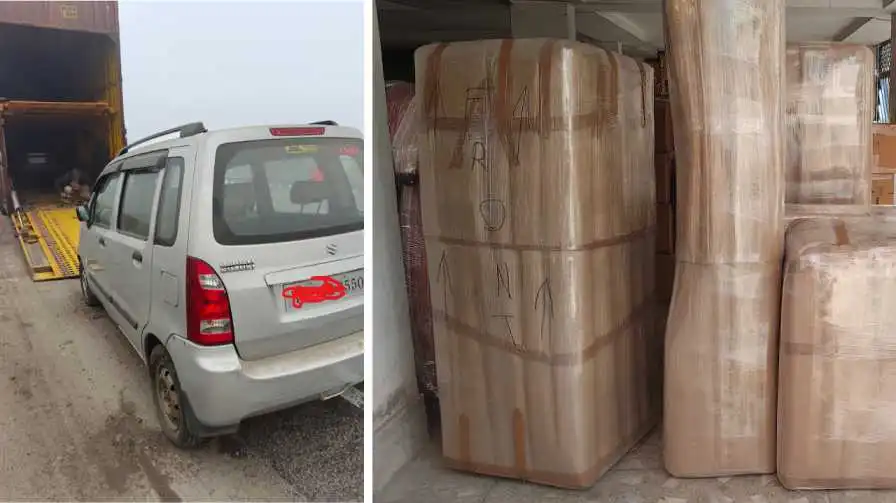
Kochi, Ernakulam or Fort Kochi: pin the actual receiving door
Kochi is not one unloading point. The district administration describes the city corporation as formed from areas that include Ernakulam, Mattancherry, Fort Kochi and Willingdon Island, among others. Fort Kochi lies on the western side of the city, about 12 km from Ernakulam town. A booking that only says Kochi or Cochin leaves the most important part of the last mile undefined.
Why the broad name causes problems
Two addresses that both say Kochi can need very different arrivals. One may have a wide approach road and a service lift. Another may sit on a narrow lane where a long-haul truck cannot stop near the door. Passenger ferry times between parts of the city are no guide to how a goods vehicle gets there either. The truck needs a road route to a point where it can actually stop and unload.
What to give the coordinator before loading
- The building or house name and door number
- The full address with PIN code
- The locality as residents name it, for example Ernakulam North, Kakkanad, Edappally, Fort Kochi or Mattancherry
- The truck entrance, if different from the main gate
- The name and phone number of the person receiving the goods
- The floor, and whether a lift is available and usable for furniture
- Where the truck can stop, and the walking distance from there to the door
- Any approved unloading window set by the building or association
- A map pin of the exact door, not just the locality
Does a different locality cost more?
Not automatically. The locality name alone does not change the price. What can change it is the actual work: a long carry, extra floors by stairs, or a smaller vehicle to shuttle goods from the truck to a lane it cannot enter. If any of these apply, agree them in writing before the truck leaves Noida, so the cost is known rather than found at the gate.
Agree the unloading job before the truck leaves Noida
The Kochi unloading team may differ from the Noida packing crew. Settle its responsibilities in a short written work order before loading, so the customer, coordinator and receiver can refer to the same inventory and scope.
| Point | What to write down |
|---|---|
| Destination lead | The name and phone number of the coordinator or crew lead responsible in Kochi |
| Labour | Who arranges the people doing the unloading, and how many are planned |
| Actual work | Unloading from the vehicle, carry to the door, floors and lift or stairs, placing items in rooms, assembly, and unpacking if agreed |
| Volume | The carton and item count or the inventory reference the work is based on |
| Access window | The gate or lift booking time and the receiving contact at the building |
| Charges | Each agreed charge itemised, including any long carry, shuttle, stairs, tolls, parking or waiting, and whether GST applies |
| Changes | Who can approve extra work on the day, and that it must be confirmed in writing or by message |
| Receipts | A receipt for every payment, with what it was for |
Pay for agreed work, once, against a receipt
Every rupee paid at the destination should match work that was agreed and actually carried out. If someone asks for a payment that is not on the work order, or asks to be paid for work that is not being done, do not pay on the spot. Call the named coordinator, ask for the request in writing, and settle it through the agreed route. Do not pay twice for something already included in the quote.
When unloading finishes
- Check the cartons and items against the numbered inventory before the crew leaves.
- Note any missing, damaged or wet item on the delivery copy, with the carton number.
- Photograph anything damaged before moving it further.
- Collect receipts for anything paid at the door, and keep them with your inventory.
A rain-ready plan for receiving in Kochi
Kochi can see heavy rain, and an unloading day can coincide with a downpour. You cannot plan away the weather, but you can plan what happens if it rains while your goods are going in.
If it is raining on delivery day
- Ask whether the truck can stop under cover, such as a porch, stilt parking or a covered entrance.
- Agree the route from the truck to the door and keep it as short as possible.
- Prepare a dry staging area inside; where elevation is needed, use a stable, load-rated platform agreed with the crew rather than a damp floor or loose planks.
- If goods would be exposed to heavy rain between the truck and the door, it is reasonable to pause unloading until there is a break or a covered route. Before dispatch, agree the fallback if that pause misses the approved unloading slot: a safe waiting point or another permitted slot, who authorises the change and who has custody. Record any waiting, holding, extra handling or second-visit charge in the unloading work order.
Spotting and recording wet cartons
Check each carton as it comes in. If one is damp or wet, note its inventory number, take a photo and record the time; agree a safe inspection with the crew in the dry staging area. Record what you find on the delivery copy before the crew leaves. A dated record tied to the carton number is far more useful later than a general note saying some boxes were wet.
Wet electrical items
If a television, microwave, washing machine or any other electrical item has got wet, do not switch it on to test it. Drying the outside does not mean the inside is safe. Leave it unplugged and have a qualified technician inspect it before it goes back into use.
What packing can and cannot do
Covers, film and careful stacking reduce the chance of water reaching your goods, but no ordinary household packing makes a load waterproof. Packing damp items, such as freshly washed clothes, can lead to mould on a multi-day trip, so make sure everything is dry before packing day. For affected non-electrical goods, agree safe inspection and drying after recording the condition; leave wet electricals unplugged pending a qualified check.
Keys and the receiving slot: load now or move the date?
Check that the Kochi receiving door will be available throughout the proposed delivery window. Sometimes the new home is not handed over yet, the society has not approved a slot, or nobody is in the city to receive the goods. Deciding this before loading is much easier than deciding it at the gate.
Check this before you load
- Who will receive the goods in Kochi, and on which days they are available
- Whether you will have the keys or access by the expected delivery window
- Whether the building has approved an unloading slot, if it requires one
- Whether there is a dry space ready to take the goods in
If the Kochi side is not ready
You have two sensible options. You can move the pickup date in writing so the goods leave Noida later, or you can agree a holding arrangement in advance. Loading on the hope that the keys will turn up in time often leads to waiting charges or an unplanned holding cost.
If goods have to be held
Before agreeing to any holding, get these points in writing:
- Who has custody of the goods while they are held
- Where they will be kept
- Whether and how you can access them in the meantime
- The expected duration, and what happens if it runs longer
- The holding charges and how they are calculated
- The redelivery window once you are ready, and its cost
Holding is arranged per move and charged as agreed. Do not assume it is free or available at short notice.
Few items, PG rooms and office assets
Not every Noida to Kochi move is a full home. Students, people leaving a PG room, and small offices sending equipment need a plan that fits a smaller or different kind of load.
Students, PG rooms and a handful of items
Start with a simple list: cartons of clothes and books, a study table or chair, a bike, perhaps a small fridge or a mattress. Give approximate sizes and weights where you can. With that list, the coordinator can suggest whether a shared load makes sense and what the window is likely to be. For very small loads, compare the cost of a shared load against what you can reasonably carry or send another way. Moving a mattress or a few cartons does not always need the same service as a home. Pricing for small loads is based on the inventory, packing and access, so a clear list gets a clearer answer than asking for a price per kilo.
Office equipment and physical assets
For an office, the inventory should separate furniture, IT equipment, files and any shared equipment such as printers or network gear. The physical move is only part of the job. The IT side should be handled by a qualified person on your team or your IT provider:
- Back up data before anything is shut down, and verify that the backup works.
- Shut down servers and devices properly rather than simply unplugging them.
- Label cables and ports so equipment can be reconnected correctly in Kochi.
- Plan who will recommission systems at the destination and test them before use.
- Keep passwords and access credentials private. They should never be written on cartons or shared with the moving crew.
Commercial goods and business assets can need different paperwork from household effects, so confirm the document requirements with the operator and your accountant before the booking is fixed.
Moving a car or bike from Noida to Kochi
A vehicle is a separate job, even when it moves at the same time as your household goods. It is assessed on its own, given its own pickup and handover plan, and priced after that assessment.
Assessment
Share the make, model, condition and whether it runs, along with the pickup point in Noida and the handover point in Kochi. The mode, carrier type and schedule are agreed after this assessment, not assumed. Do not take an enclosed carrier or delivery with your household goods for granted. Ask what is proposed and get it in writing.
Handover record in Noida
- Photograph the vehicle from all sides, including existing scratches and dents, with the date visible.
- Note the odometer reading.
- Record the number of keys handed over.
- Keep copies of the registration certificate and insurance, and hand over only the copies the operator asks for.
- Remove personal belongings and loose accessories. Agree the FASTag arrangement with the operator before handover.
Fuel, battery and EV instructions
Follow the operator's instructions on how much fuel to leave in the tank, and the manufacturer's guidance on battery and any special settings. For an electric vehicle or an electric scooter, ask both the operator and the maker about the charge level and transport requirements before handover, and tell the coordinator early that it is an EV.
Delivery in Kochi
At handover, compare the vehicle with your photos and the odometer reading before signing. Note any new marks on the delivery record. As with household goods, the handover point should be a specific address where a carrier can stop, not just the city name.
Paperwork, e-way bill questions and optional transit cover
Household moves need less paperwork than many people expect, but the papers you do need should be ready before loading.
Documents for a household move
- A photo identity document and your current address details
- The full Kochi delivery address and a receiving contact
- The signed inventory, with a copy kept by you
- The written quote showing scope, charges, applicable GST and any selected cover
- For vehicles, copies of the registration certificate and insurance as requested
Do I need an e-way bill?
Under the GST e-way bill rules, used personal and household effects are generally on the list of goods exempt from the e-way bill requirement. If the consignment includes new goods, commercial stock or business assets, the position can differ. Check it with the operator and, for business goods, with your accountant before the move.
Optional transit cover
Cover is optional, and its terms should be stated in your quote rather than assumed. Before selecting it, ask about the following:
- How the declared value is set, and whether you list values per item or for the whole consignment
- What is excluded, such as items packed by you, pre-existing damage, or certain fragile or high-value goods
- The deadline for reporting damage or loss after delivery
- What records a claim needs: usually the signed inventory, delivery notes, photos and receipts
Cover does not replace careful packing and a good delivery check. The clearer your inventory and delivery record, the simpler any claim will be.
Valuables and important papers
Keep jewellery, cash, passports, certificates, property papers and data drives under your own control rather than in the household load. They are hard to replace, and many cover terms limit or exclude them.
How booking works, from first call to the last carton
A long move goes more smoothly when every decision is made in the right order. This is how a Noida to Kochi booking usually runs.
- Make an enquiry by calling +91 94671 86002 or filling in the enquiry form on this page. Include your Noida pickup address, your Kochi delivery address as precisely as you know it, your preferred dates, and a rough list of what is moving.
- Review the inventory, by video or in person where needed. Mention lift access, stairs, the truck stopping point, fragile pieces, vehicles and anything you want dismantled or reassembled.
- Receive a written quote that sets out the scope, the mode, the provisional window, applicable GST, any selected cover, and the separately priced items that apply to your move.
- Confirm the booking only once you are clear on payment terms and on how date changes and cancellations are handled. Both should be in writing before any advance is paid.
- Fix the details on both ends: the Noida gate pass and loading window, and the exact Kochi door, receiving contact and unloading work order.
- On packing day, check and sign the inventory, keep your copy, and confirm the destination contact once more before the vehicle leaves.
- During transit, use the update method agreed at booking, whether calls or messages with the coordinator.
- At delivery, receive the goods against the inventory and the work order, record anything missing, damaged or wet, and collect receipts for anything paid.
Before you pay any advance
Make sure you have the quote in writing, with the payment schedule and what each payment covers. Ask what happens to the advance if you change or cancel the move, and keep the written answer with your quote.
If your dates change
Tell the coordinator as soon as you know. Moving the pickup is usually simpler than holding goods once they are loaded. Ask for the revised date, and any change in cost, to be confirmed in writing.
Why enquire with ALPM, and how to compare any mover
Choosing a mover for a 2,700 km job is about knowing who you are dealing with and what you are agreeing to. Here is what you get when you enquire with us, and a checklist you can use to compare any quote, including ours.
Who you are dealing with
AGARWAL LOGISTICS PACKERS AND MOVERS, also known as Agarwal (ALPM) Packers and Movers, is a GST-registered business with GSTIN 36FDRPM0957B1ZC and trademark registration number 7901417. Its registered location is in Old Bowenpally, Secunderabad, Telangana. When you call +91 94671 86002 or use the form on this page, your enquiry comes directly to this named business rather than being passed around a listing platform.
How we approach a Noida to Kochi move
We plan from an itemised inventory, not a guess based on the number of rooms. The quote sets out what is in scope, what is priced separately and what you have chosen to add, so you can see where every part of the price comes from. Our services cover household packing and moving, office goods, intercity transport, assessed car and bike coordination, and storage on request. The final mode, scope and availability are agreed for each move.
A checklist for comparing quotes
- Does the quote name the business, with a GSTIN you can check?
- Is it based on your inventory, and does it state the mode and what the time window covers?
- Are packing, loading, transport and unloading listed clearly, with packing counted only once?
- Are GST, cover, storage, stairs, long carry, shuttle, tolls and parking either included or priced separately?
- Does it name a destination contact and describe the unloading work?
- Are payment terms, date changes and cancellation explained in writing before any advance?
- Are cover terms stated, including declared value, exclusions and the claim deadline?
- Do any promises sound absolute, such as guaranteed dates, waterproof transit or zero risk? Ask how they would be delivered.