

Packers and Movers Noida to Agra
Noida to Agra is about 200 km by the Yamuna Expressway. For a dedicated load, plan a 1–2 day allowance from packing to unloading. A 2 BHK guide runs ₹14,500–₹22,500. One calendar day works only if packing, loading, the drive, unloading and reassembly all fit your confirmed windows.
Noida to Agra moving overview
| Route distance | About 200 km; observed car routes 198–201 km via Yamuna Expressway |
| 2BHK planning guide | ₹14,500–₹22,500; confirm inventory, mode and access |
| Dedicated calendar | 1–2 days from packing to unloading; same-day depends on both windows |
| Shared calendar | Provisional 2–3 days pickup to unloading, including agreed consolidation |
| Agra address | Exact tehsil/locality, actual unloading entrance, keys and receiver |
Get Free Quote
On this pageView sections
Noida to Agra route: about 200 km on the Yamuna Expressway
Map apps put the Noida Agra distance at roughly 198 to 201 km for a car. The map summaries identify 198 km via Yamuna Expressway and NH19, and 201 km via Yamuna Expressway. Both were read on 18 October 2026. For planning, use about 200 km. Your actual distance depends on the Noida pickup address, the Agra receiving address and the exit a truck can use, so treat 200 km as a planning figure and not a billing distance.
The same maps show a car drive of about 2 hours 45 minutes. That is a passenger-car estimate. Packing, handling and delivery appointments are separate, and a loaded goods vehicle needs its own route and operating allowance. It says very little about how long a household move takes, and the worksheets below show why.
The corridor in plain terms
A typical move runs from your Noida pickup to the Greater Noida connection, onto the Yamuna Expressway, off at the Agra exit and then along city or district roads to the exact door. The expressway passes close to Mathura and Vrindavan, but we do not assume a stop in either place and we do not treat a stop there as the same quote. A detour, an intermediate drop or a second pickup changes the route and is quoted on its own.
What distance does and does not decide
- Distance sets the freight part of the quote. Floors, carry distance, packing volume and the delivery slot often move the total more than a few extra kilometres.
- Agra is a district as well as a city, so the word Agra alone does not tell a driver where the truck is going. Worksheet 2 deals with that.
- Toll, parking and waiting charges depend on the vehicle and the day. Ask whether they sit inside the quoted figure or on top of it, and count each only once.
House shifting Noida to Agra: 1, 2 and 3 BHK and larger homes
For a household move, the written quote is built from your inventory, not from the BHK label. A 2 BHK with a large wardrobe set and a full kitchen is a different job from a lightly furnished 2 BHK. The bands below are planning guides, and they show roughly where a quote should land before the inventory adjusts it.
| Home size | Guide band | What usually moves the figure |
|---|---|---|
| 1 BHK | ₹9,500–₹13,500 | Number of cartons, one large item or several, floor and lift |
| 2 BHK | ₹14,500–₹22,500 | Beds and wardrobes to dismantle, kitchen volume, long carry |
| 3 BHK | ₹22,500–₹35,500 | Furniture volume, number of fragile items, vehicle size |
| 4 BHK or villa | Assessed individually | Inventory, access and number of vehicles |
What the service covers
Room-by-room packing in cartons, with the contents and the room name recorded on each carton, wrapping of furniture, loading, transport to Agra and unloading at the agreed point. Which of unpacking and furniture reassembly are in the base figure, and which are priced separately, should be stated in the quote. Do not assume unpacking is included because another mover includes it, and do not assume it is excluded either.
Room by room
- Bedrooms: beds and wardrobes are dismantled where needed, mattresses are protected, and clothes go into cartons.
- Kitchen: crockery and glassware go into padded cartons. Declare gas cylinders, fuel and other restricted items before packing; use an appropriate authorised service for prohibited or regulated goods.
- Living room: sofas are wrapped, and the television and other electronics are packed with padding or in their original cartons if you still have them.
- Bathrooms and balcony: seal liquids, and ask about plant acceptance and preparation rather than placing them in sealed household cartons.
Worksheet 1: Gate cutoff and the full-work clock
Using the map drive time alone leaves out most of the work in a Noida to Agra move. A household move has four blocks of work: packing, loading, the truck journey, and unloading with reassembly. The drive is only one of them. This worksheet adds the blocks up and tests the total against the one thing that can end the plan, the cutoff at the receiving gate.
Step 1: Find the gate cutoff
Ask the Agra society, building or shop for the latest time a truck can enter and unload, and whether the service lift or goods entrance runs on booked slots. Write down the time the window closes, not the time it opens. If nobody can confirm it, do not assume an evening arrival is allowed. Ask for the delivery slot to be kept provisional until someone does.
Step 2: Add up the full-work clock
The table shows one illustrative day for a dedicated load. These are planning allowances, not a trip we completed, and your blocks will change once the inventory and access are assessed.
| Block of work | Time | Hours |
|---|---|---|
| Packing at the Noida home | 7:00–10:00 | 3 |
| Loading | 10:00–11:00 | 1 |
| Truck journey allowance (not the map time) | 11:00–15:00 | 4 |
| Unloading in Agra | 15:00–16:30 | 1.5 |
| Listed reassembly | 16:30–17:00 | 0.5 |
| Full work clock | 7:00–17:00 | 10 |
That is ten hours of work, not a four-hour drive. The journey line is an allowance that leaves room for leaving the society, the expressway, toll lanes, a driver break and the city approach in Agra.
Step 3: Test the clock against the cutoff
- If the Agra drop window runs from 15:00 to 18:00, the clock ends at 17:00 and leaves about an hour of contingency. A one-day plan fits.
- If the drop window closes at 14:00, the same clock fails, because the truck would arrive after the gate has shut. This one-day plan does not fit the available window.
Step 4: Choose the fallback before you book
When the target window fails, there are two practical options. Packing can be done the previous day, so that move day starts at loading. Or delivery can be agreed for the next day, with the loaded goods held in the meantime. Either one needs to be written into the quote: who holds the goods, where, and what it costs. A fallback that was only discussed on the phone does not help at a closed gate.
How long to plan for
- Dedicated load: allow 1–2 days from the start of packing to unloading, once scope and access have been assessed. One day is possible only when the full clock fits confirmed windows at both ends.
- Shared load: allow a provisional 2–3 days from pickup to unloading, which includes the agreed consolidation period and the delivery slot. If consolidation may run longer, ask before you book. Packing before pickup is counted separately when you arrange it.
Worksheet 2: Agra city or district? Fix the exact address
Agra is a city and a district. The district's official tehsil page lists Agra, Bah, Etmadpur, Fatehabad, Kheragarh and Kirawali as separate tehsils. A customer who says they are moving to Agra might mean the city centre, a colony on the edge of town or a village in another tehsil. The road in, the vehicle that can reach the door and the final-leg arrangement can all differ, and so can the price.
Fill in the following for the receiving address before you ask for a quote.
- Full postal address with pin code, and the tehsil or locality name if you know it.
- The landmark you use when giving directions, written separately from the actual loading gate. A well-known landmark can sit on a different road from the gate a truck is allowed to use.
- Road width at the last turn, and whether a large vehicle has reached the building before, as reported by the receiver or the building office.
- Gate or entry rules the society or market has told you, in their words, with the name of the person who gave them.
- Name and phone number of the person who will be at the Agra address, even if you are not there yourself.
We do not assume a citywide narrow-lane rule or a blanket restriction around monuments. Some Agra lanes are tight and some areas have local entry rules, but those are facts about one street on one day, and the way to settle them is to ask at the address.
If the truck cannot reach the door
The plan then needs a shuttle handover, where goods move from the main vehicle to a smaller one at an agreed point. Who provides the smaller vehicle, where the transfer happens and what it costs must be in the quote. This page does not state a fixed shuttle fee or a fixed transfer point for the route.
Worksheet 3: Household items, shop stock and the receiver
If you are moving both a family home and shop stock, or business goods kept in one room, separate the two scopes before quoting. Putting everything on one list causes trouble later, with billing, with the e-way bill question and with the person who signs on arrival.
- Keep two inventories when two kinds of goods travel. Household effects go on one list. Shop stock, new goods and business assets go on the other, with quantities and approximate values.
- Build a carton inventory for the house by room, numbering each carton. Group the commercial list by item type, such as stock cartons, shelving and counters.
- Name the receiver for each list. The person who can accept the household goods may not be the person who can check stock.
- Record condition at pickup, in photos or notes on the inventory sheet, for anything already scratched, dented or not working.
- If a shuttle handover is needed in Agra, ask for a condition and custody check at the transfer: the crew counts the cartons leaving the main vehicle, counts those going onto the smaller one, the person responsible for the transfer signs the count and condition record, and the final receiver checks against it on arrival.
A note on paperwork
Used personal and household effects are generally exempt from the e-way bill under the GST rules. Commercial stock, new goods and business assets depend on the consignment, so check the position with the operator and your accountant before the day. Applicable GST and any transit cover you select are stated in the quote.
Worksheet 4: Measurements and written fallback responsibility
Attach measurements and a responsible contact to the access details, so a narrow approach or missed lift slot has an agreed alternative. Fill in the table and send it with your inventory.
| Item | What to measure or note | Fallback to agree in writing |
|---|---|---|
| Service lift | Door width and depth, booked slot, whether a separate goods lift exists | Stairs carry or a later slot, and whether the extra carry is charged |
| Floors and stairs | Floor number, flights of stairs, carry distance from lift or stairs to the door | Stairs or long-carry charge, stated in the quote |
| Parking distance | Distance from where the truck can stand to the building entrance | Waiting time or extra carry, and who pays |
| Vehicle access | Gate height and lane width; flag overhead obstructions in approach photos | Smaller vehicle or shuttle handover, and who arranges it |
| Large items | Size of wardrobes, fridges, sofas and beds, and whether they pass doors and the lift | Dismantle where designed, or arrange a separate qualified assessment |
| Packing volume | Rooms, loaded shelves, kitchen items and fragile pieces | Extra cartons priced before they are used |
| Car or bike | Make, model, running or not, keys and any damage already present | Non-running or premium vehicles assessed separately |
Then ask for the fallback in writing. If the vehicle cannot reach the door, if the lift is not available, if the receiver is not present or if the gate closes before arrival, what happens, who holds the goods and who pays? A reply such as we will manage it is not a fallback.
Do not approach or move overhead wires to test a vehicle gap. Have the operator assess a safe stopping point and working clearance from the approach details.
Noida pickup: society rules, lift slots and loading point
Many Noida and Greater Noida West moves start in high-rise societies. On the packing day, what the society allows often matters more than the crew: move-out permission, a service lift slot, a gate pass for the vehicle, a deposit and fixed hours for goods movement. Rules differ from society to society. Ask the resident welfare association or facility office for them in writing rather than relying on a general belief about Noida timings.
- Request the vehicle gate pass and the service lift slot before the move date is final.
- Find out where the truck can stand and how far that is from the tower entrance.
- Tell us the number of floors, whether the lift is a passenger or goods lift, and any lift protection the society requires.
- Keep one person at the Noida end who can sign the inventory and decide what stays behind.
- For sector houses, check lane width and parking at the front of the house for a large vehicle.
The road leg begins at your pickup address, runs through the Greater Noida connection and joins the Yamuna Expressway. A pickup near that connection can shorten the first part of the journey allowance in Worksheet 1, while one deeper inside an older sector can lengthen it.
Few items: when a full vehicle is more than you need
Students, single professionals and people sending a few pieces ahead to a flat in Agra often need something between a courier and a house move: a bed, a fridge, a washing machine, a few cartons. Small-load cost is assessed from dimensions, item count, volume, packing and the available loading arrangement.
To get an assessed quote, send the following.
- A list of items, with approximate length, width and height for each large piece.
- The number of cartons or bags, and whether any are heavy, such as books.
- Floor and lift details at the pickup and at the Agra address.
- Whether the goods should travel alone or with other consignments, and whether you can accept a 2–3 day shared window.
Few-item moves are the most likely to travel as shared loads, so the consolidation question applies in full. Ask when the vehicle is expected to dispatch, not only when your goods will be collected.
Office shifting Noida to Agra: physical equipment
An office quote is based on what has to be physically moved, not on how many people work there. Ten desks with ten computers and two printers is a different job from ten people with laptops and one shared table. Make an asset list: desks, chairs, cabinets, computers and monitors, printers, network equipment, files and boxes of stationery.
| Office size | Guide band | Basis |
|---|---|---|
| Small office | ₹21,000–₹29,500 | Asset list, not headcount |
| Medium office | ₹30,500–₹44,500 | Asset list, not headcount |
These bands come from published up-to-400 km office figures applied to this route of about 200 km. Read them as a planning range, and expect the written quote to be built from your own asset list. Commissioning IT equipment, such as reconnecting servers, configuring networks and setting up workstations, needs a qualified technician and is an extra. The move itself covers packing, carrying, loading, transport and unloading.
Before the day
- Back up your data and keep your own copy of passwords and licence keys. Carry storage devices that hold sensitive data yourself if you can.
- Label each workstation's cables and equipment with the same tag, so reconnection is faster.
- Decide who signs for stock and who signs for assets, as in Worksheet 3.
- Check the goods-entry hours of the receiving building in Agra.
- For commercial assets and new goods, check the e-way bill position with the operator and your accountant.
Car and bike transport Noida to Agra
List your car or bike separately from the furniture, with its model, running condition and collection and delivery points. Its carrier arrangement and calendar may differ from the household load.
| Vehicle | Guide band | Note |
|---|---|---|
| Car | ₹4,000–₹6,700 | General assessed band. Premium, non-running and electric vehicles are assessed separately |
| Bike | ₹2,700–₹5,800 | General assessed band. Premium or non-running bikes are assessed separately |
These are general planning bands. They do not promise a particular body class, engine displacement or an enclosed carrier. What you get depends on the vehicle, the carrier or operator arranged, and the pickup and drop arrangement. Ask for confirmation in writing of the carrier or operator, whether it is open or enclosed, where the vehicle is collected and dropped, and any preparation expected for your model.
Preparing the vehicle
- Agree fuel and battery preparation with the operator for the specific model.
- Remove personal belongings and anything loose, including documents, chargers and toll tags you do not want read en route. Ask how the operator handles a FASTag on a carried vehicle.
- Photograph all sides, the dashboard and the odometer, and any existing scratches, with the date visible.
- Confirm required RC, ID and insurance copies, record the keys handed over and name the person authorised to receive the vehicle.
- For bikes, note fuel and battery condition, and ask how the bike will be secured.
Packing only, packing materials and holding availability
Some people want goods packed in Noida and then arrange their own vehicle, or want packing done the day before the move. That can be arranged as a separate service. The quote then states the packing date, the cartons used, where the packed cartons will stay until pickup, and who is responsible for them in the meantime.
Packing materials
Ask what the quote lists: corrugated cartons, bubble wrap, stretch film, tape, edge protectors and blankets for furniture. Ask whether materials are inside the base figure or billed per carton. If they are in the base figure, they should not reappear as a second line.
Holding availability
If the delivery window fails or your new home is not ready, goods may need to be held for a day or more. Holding can be requested. Availability, location, duration and charge are agreed for each move, and this page does not publish storage specifications. Ask for the terms in writing: where the goods stay, who has access, how condition is recorded when goods go in and come out, and the daily or weekly charge.
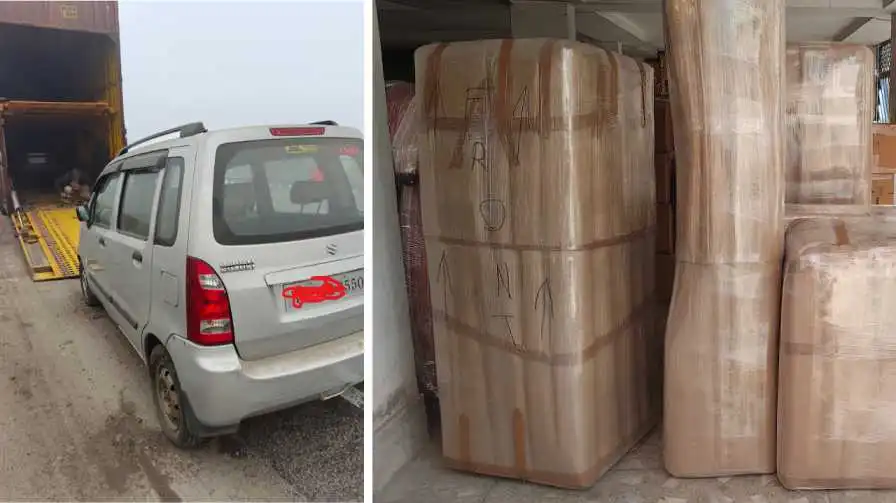
Getting ready: privacy, appliances, transit locks and restart
Privacy and valuables
- Keep jewellery, cash, passports, property papers and personal recovery credentials securely with you. Follow employer-authorised custody procedures for confidential business files and equipment.
- Keep personal documents in a bag that stays with you, and put away anything private before the crew arrives, such as medical papers, photographs and financial statements.
- Back up phones, laptops and office computers and sign out of personal accounts before handover.
- Send ID copies only if the quote asks for them, and only to the named business contact.
Appliance orientation
Follow the manufacturer's manual for each model you own. As a general approach, the points below apply, and the manual overrides them.
- Refrigerator: empty it, defrost and dry it, and secure the door as the manual says. Keep it in the orientation the manual allows for transport.
- Washing machine: drain the hoses and fit the transport bolts or drum locks where the model requires them. If they are missing, ask the manufacturer about the correct replacement or transport procedure.
- Air conditioner: indoor and outdoor units need a qualified technician to disconnect and refit. Reinstallation is not part of a move unless the quote says so.
- Television and electronics: use original cartons if you have them, and keep screens protected.
- Microwave: secure or separately pack the loose turntable. Printer: secure moving parts and handle cartridges only as its manual instructs.
Transit locks
Fit model-required transport locks before moving. Keep loose accessories and removed furniture fittings in labelled bags. Protect finishes when securing doors or drawers, and list anything removed on the inventory.
Restart at Agra
Do not switch everything on at once. Have any uncertain electrical point checked by a qualified person. Follow the manufacturer's restart instructions, including how long a refrigerator or air conditioner should stand before use, and remove transit locks before first use. If an appliance does not work, note it on the delivery paperwork on the day.
Noida to Agra shifting charges: what is in the number and what is not
Every figure on this page is a planning guide. The number that counts is the written quote built from your inventory, mode and access. The guide bands tell you whether a quote is in the right area. They do not replace one.
A worked example
This example is illustrative only. Suppose a 2 BHK quote has a base figure of ₹17,000, and the access check agrees a long carry at ₹1,000. That makes ₹18,000 before any applicable tax, selected transit cover and other listed charges, with packing counted once. It sits inside the ₹14,500–₹22,500 guide. It is not a customer invoice.
What a base figure should state
- Packing, loading, transport and unloading, each listed as included or not.
- Whether unpacking and furniture reassembly are in the base figure.
- The number and type of vehicles, and whether the load is dedicated or shared.
Items to confirm as included or separate
- Tolls and parking. This page gives no fixed toll figure. Ask whether tolls sit inside the quote or are billed separately, and count them once.
- Stairs and long carry.
- Shuttle vehicle and handover.
- Waiting time at either end.
- Holding or storage.
- A technician for IT commissioning or appliance installation.
- Transit cover.
- GST. The applicable rate is stated in the quote, and no blanket rate is assumed here.
Transit cover
Cover is a selected option stated in the quote, with the declared value, the terms and what is excluded. Blanket cover on every move is not promised. For anything of high value, ask what the cover means in practice, including how a claim is reported.
Billing
Ask for an itemised bill that matches the quote, issued in the name of the business on the quote, with GST shown as the quote says. If an employer requires a particular approved-transporter format or approval, send that requirement before booking, because no employer-specific approval is promised.
How a move runs, from enquiry to unloading
- Enquiry. Use the form on this page or call +91 94671 86002. Give the pickup and delivery addresses with pin codes, the date you are aiming for and a rough inventory. Add the Agra tehsil or locality if you know it.
- Assessment. The inventory, the access details from the worksheets and the delivery window are reviewed, and anything missing is asked for. Photos or a short video of large items help for bigger homes.
- Written quote. It states the mode, scope, inclusions, items to confirm, cover, tax, payment and cancellation terms and the fallback if the window fails.
- Booking and confirmation. The date, the vehicle arrangement and the crew arrival time are confirmed, and contact numbers at both ends are updated. Confirm the receiver, keys and usable unloading window before loading starts.
- Packing and sign-off. Cartons are counted and numbered, condition notes are recorded and valuables stay with you.
- Loading and departure. Loading follows the inventory, and the arrival allowance is rechecked against the confirmed gate cutoff before departure.
- Delivery in Agra. Goods are unloaded at the agreed point. If a shuttle handover is needed, cartons are counted at the transfer. Reassembly follows as listed, and the delivery paperwork is signed with any damage or shortage noted.
- After delivery. Report any issue as described in the terms section below.
Why enquire with ALPM, and how to compare any mover
Bring your inventory, Noida loading point and Agra address record to one ALPM enquiry. The written plan should connect the vehicle arrangement to the access measurements and show whether the full work clock fits the receiving window. Keep the packing, furniture work and any shuttle or holding arrangement visible in the scope.
Compare the same work across quotes using the questions below.
| Question | A usable answer | A warning sign |
|---|---|---|
| Is the figure based on my inventory? | An itemised list and a stated mode | A price given before anyone asks what you are moving |
| What is included? | Packing, loading, transport and unloading listed, with unpacking and reassembly stated | All inclusive, with no list |
| What about tolls, parking, stairs and waiting? | Each marked included or separate | Charges that first appear at delivery |
| How long will it take? | Dedicated or shared stated, with a window and a gate-cutoff check | Same day promised without seeing either address |
| Who is the contracting business? | A named business, GST details and written terms | Only a mobile number |
| What does transit cover mean? | Terms, declared value and exclusions in writing | Fully insured, with no terms |
| What if the plan fails? | A written fallback that names who holds the goods and who pays | A verbal assurance |
Damage, cancellation, rescheduling and payment: settle these in writing
These terms vary by move and are agreed in the written quote. This section lists what to ask for, rather than quoting fixed terms that may not apply to your move.
Damage and shortage
- Check the cartons against the inventory at delivery, before the crew leaves.
- Note visible damage and any shortage on the delivery paperwork on the day, and take photographs.
- For damage found when you unpack, ask what the reporting period is and how to report it.
- Ask how claims are assessed, what proof is needed and what the cover you chose pays for.
Cancellation and rescheduling
Ask whether any notice period allows cancellation or a date change without a charge, what applies at each booking stage, and what happens if you cancel after packing materials or a vehicle have been committed. Ask too what happens if the date has to move because of an access or gate problem at either end.
Payment
- How much, if anything, is payable in advance, what the balance is, and when it is due.
- Which payment modes are accepted, and in whose name the receipt is issued.
- Any amounts payable on delivery, such as holding or extra carry, and how they are confirmed before they are charged.